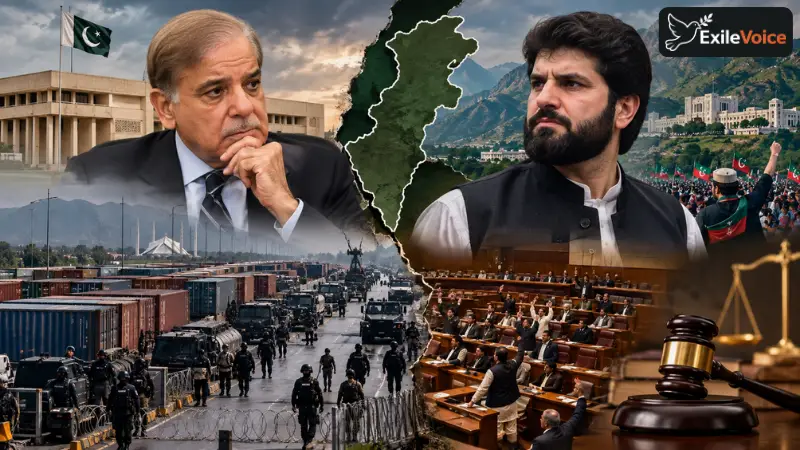
Federal-provincial relations in Pakistan have reached severe strain as rumors intensify regarding the potential imposition of Emergency rule or Governor’s Rule under Articles 232 and 234 of the Constitution in Khyber Pakhtunkhwa (KP). As Prime Minister Shehbaz Sharif returns to Islamabad to chair high-level security and ministerial consultations, political circles are watching closely to see if the federal government will execute aggressive constitutional measures to curb growing provincial resistance led by KP Chief Minister Sohail Afridi.
The legal and constitutional framework governing such executive measures remains complex. Constitutional experts, including retired senior jurists, point out that invoking Article 232 or enforcing Governor's Rule in a province is not a straightforward administrative maneuver. Under current constitutional jurisprudence, declaring state emergency or suspending provincial legislative authority requires formal legislative sanction and specific procedural thresholds, including approval or ratification through parliament or provincial assemblies within strict timeframes. Attempting to bypass these checks without legislative backing risks immediate legal challenge in the superior judiciary.
Despite legal hurdles, reports from Islamabad indicate that political engineering strategies may be deployed to alter the numeric strength in the KP Provincial Assembly. Whispers of targeted disappearances or floor-crossing by dozens of members of the provincial assembly (MPAs) reflect the escalating high-stakes political conflict between federal authorities and the provincial administration. Such moves could severely compromise institutional integrity and exacerbate political instability across the region.
Compounding this political friction is the federal government's containment strategy within the federal capital. International news outlets report that Islamabad has been turned into a fortress, with over 3,500 shipping containers blocking major arteries and up to 18,000 security personnel deployed daily. The financial toll of maintaining this continuous state of blockade is estimated at approximately $300,000 (nearly 100 million PKR) per day in logistical and operational expenditures alone, placing immense stress on an already fragile national economy.
Meanwhile, back-door communication channels between the federal government and opposition leaders have reportedly stalled. Federal authorities continue to demand the absolute cancellation of planned opposition long marches before initiating dialogue, a condition rejected by young, uncompromising political figures like Chief Minister Sohail Afridi. As both sides remain locked in maximalist positions, the risk of judicial intervention, institutional standoffs, and administrative paralysis in KP continues to grow, exposing the deep structural challenges within Pakistan's federal framework.