Pakistan faces a sharp escalation in internal security threats following a series of coordinated, highly tactical violent assaults across Balochistan and Khyber Pakhtunkhwa. Recent incidents highlight a qualitative shift in combat tactics, operational capability, and geographic reach among non-state armed groups, creating severe security challenges for law enforcement agencies and state institutions.
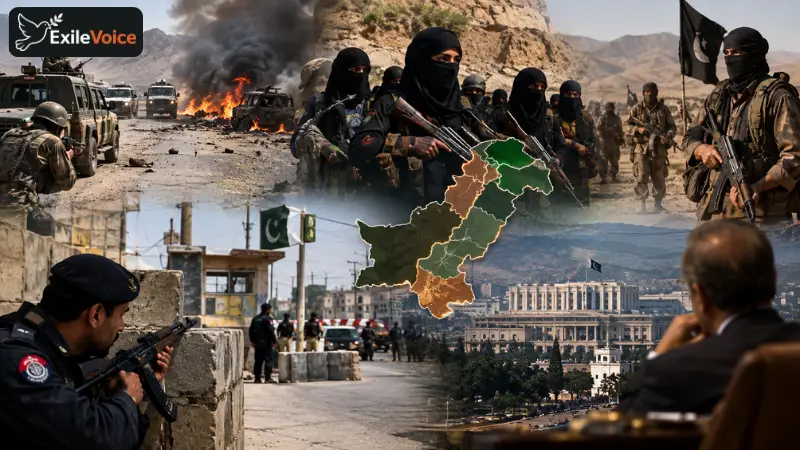
In Balochistan's Dera Bugti region, an ambush on a military convoy resulted in multiple casualties among Frontier Corps (FC) personnel and civilian transport drivers, despite counter-engagement efforts that neutralized four attackers. Concurrently, a video released from Turbat depicted an attack on a three-vehicle army convoy executed by the Baloch Liberation Army (BLA). The media captured in that event revealed an alarming operational detail: the direct combat involvement of over ten heavily trained female militants utilizing advanced automatic weaponry at close range without tactical retreat.
Simultaneously, security dynamics in Khyber Pakhtunkhwa continue to deteriorate, exemplified by a direct assault on a police checkpost in Peshawar that left law enforcement personnel injured. Beyond traditional conflict zones, security intelligence indicates an alarming expansion of militant reach into Sindh. The Tehreek-e-Taliban Pakistan (TTP) recently released video statements claiming a formalized administrative and operational footprint in Sindh, signaling an intention to open new urban fronts outside their traditional strongholds in the northwest.
These developments occur against a backdrop of complex political maneuvering over provincial restructuring proposals, particularly discussions regarding the potential administrative division of Sindh. Senior political figures, including former President Asif Ali Zardari, have firmly opposed any division of the province. Analysts suggest that the sudden resurgence of militant messaging in urban Sindh during intense political discussions over administrative boundaries underscores how security vulnerabilities are frequently intertwined with broader political instability.
The sharp increase in sophisticated attacks underscores a critical mismatch between state focus and operational security realities. Senior political commentators and public figures have voiced growing concern that institutional energy spent on political management, opposition containment, and urban blockades in Islamabad diverts vital resources away from counter-terrorism efforts in volatile border regions. Without a recalibration of national priorities back toward strategic security coordination and police intelligence enhancements, Pakistan risks allowing militant factions to solidify their positions across multiple provinces simultaneously.