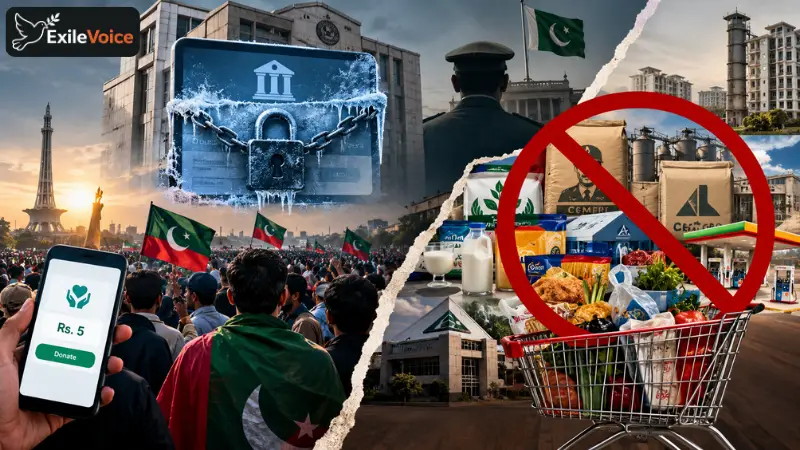
The intersection of state regulatory authority and political campaign financing has reached a critical juncture in Pakistan, following the recent suspension of a major political donation account. In a move that has sparked widespread debate on the boundaries of civil resistance and state suppression, the State Bank of Pakistan and allied regulatory bodies reportedly blocked a Muslim Commercial Bank account established by the Pakistan Tehreek-e-Insaf (PTI). This account was explicitly created to crowdfund the upcoming September 27 political long march. The unprecedented influx of micro-donations from ordinary citizens, ranging from minor contributions of five rupees to larger sums, demonstrated a massive grassroots mobilization. The abrupt freezing of these funds not only curtails the financial viability of opposition rallies but also sets a complex precedent regarding the state's control over democratic financial participation.
This financial blockade has catalyzed a strategic pivot within the political opposition. Faced with legal roadblocks, widespread detentions of party leadership, and the neutralizing of conventional protest avenues, political analysts and opposition voices have introduced a paradigm shift toward non-violent economic resistance. The core strategy being advocated is a comprehensive social and commercial boycott of enterprises linked to the military and state establishment. By targeting the commercial footprint of these entities, the opposition aims to apply financial pressure where traditional political dialogue has stalled.
The proposed economic boycott encompasses a vast and deeply entrenched network of commercial entities that dominate the Pakistani consumer market. The strategic call specifically targets major institutional investments and everyday consumer brands alike. At the forefront of this movement is a push to halt investments in large-scale real estate developments, notably the Defense Housing Authority projects, which rely heavily on capital from both local and overseas Pakistanis. The strategy emphasizes that withholding real estate investments could significantly disrupt the capital flow that sustains state-aligned commercial empires.
Beyond real estate, the boycott extends deeply into the agricultural and construction sectors, urging consumers and builders to pivot away from brands like Fauji Fertilizer, Askari Cement, and Fauji Cement. In the fast-moving consumer goods sector, the resistance calls for an absolute halt in the purchasing of daily necessities produced by state-affiliated entities. Brands such as Nurpur dairy products, OPA pasta, Fauji Cereals, and Fauji Fresh n Freeze frozen foods have been explicitly highlighted. The comprehensive list of targeted enterprises also includes financial services such as Askari Bank and Askari Life Insurance, alongside retail fuel distributors like Askari Fuels. The breadth of this boycott underscores how deeply state-affiliated conglomerates are woven into the fabric of the national economy.
The rationale driving this non-violent economic resistance is rooted in the belief that direct physical confrontation with a heavily armed state apparatus is both futile and detrimental to democratic progress. Proponents argue that the funds generated through these consumer purchases inadvertently finance the very mechanisms of political suppression they are fighting against. By redirecting consumer spending toward independent, private sector alternatives, citizens can peacefully register their dissent while structurally challenging the financial underpinnings of the establishment. This approach draws heavily on historical models of civil disobedience, emphasizing that the withdrawal of economic cooperation is a potent tool for disenfranchised populations.
However, implementing a boycott of this magnitude presents significant logistical and cultural challenges. The targeted brands enjoy massive market penetration, and finding viable substitutes requires a concerted behavioral shift among the populace. The ultimate success of this strategy relies entirely on grassroots communication, community enforcement, and the willingness of ordinary citizens to inconvenience themselves for a broader political objective. If sustained, this localized economic resistance could redefine the landscape of political activism in Pakistan, shifting the battleground from the streets to the consumer market. It tests the resilience of an opposition movement that has been systematically deprived of traditional political platforms, forcing it to explore the untested waters of mass economic non-cooperation.