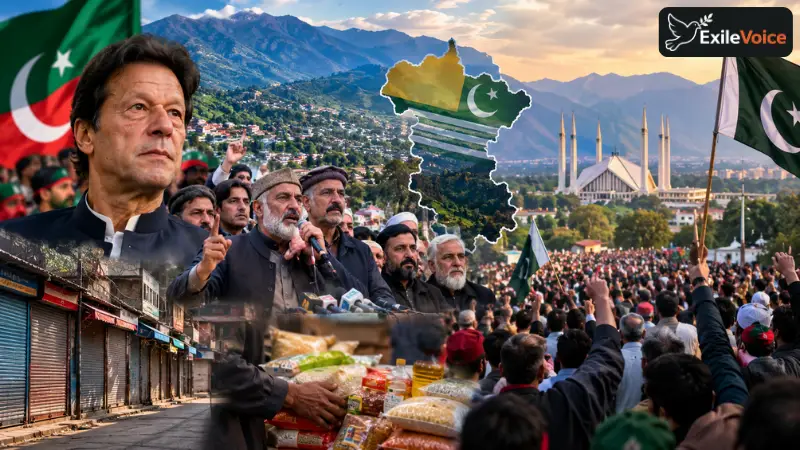
The political landscape in Pakistan and Azad Jammu & Kashmir (AJK) stands at a critical juncture following a major resolution issued by the Jammu Kashmir Joint Public Action Committee (JKJPAC) from Rawalakot. Following months of civil unrest, public strikes, and political volatility across the region, the committee leadership, spearheaded by prominent civil figures including Sardar Umar Nazir Kashmiri, announced a structured deadline ending October 3, directing local business communities to reopen markets while advising citizens to stockpile essential goods for two months ahead of a definitive operational announcement slated for October 4.
This latest declaration presents a pivotal moment for Pakistan’s opposition politics, specifically for the Pakistan Tehreek-e-Insaf (PTI). Political analysts highlight that during earlier civil rights movements in the region, where public mobilization led to widespread demonstrations and tragic loss of human lives, opposition forces missed a vital strategic window to align their national agitation with Kashmir’s grassroots resistance. The decision of the JKJPAC to reset its operational mandate provides a rare second chance for national political stakeholders to establish a unified front regarding fundamental civil liberties and constitutional rights.
Historically, civil movements in AJK have operated independently of traditional political parties, driven primarily by socioeconomic grievances, electricity tariff disputes, and basic civil rights demands. However, the sheer scale of recent mobilizations and the resilience demonstrated by local populations have reshaped regional dynamics. With 93 lives tragically lost during earlier clashes, the public resolve in AJK has solidified into a highly disciplined, peaceful resistance movement capable of sustained economic and administrative pressure.
From a strategic perspective, a convergence between the PTI leadership and the JKJPAC could fundamentally alter the geopolitical equation in Islamabad. Political observers argue that an aligned movement, drawing strength from both Khyber Pakhtunkhwa in the north and AJK in the northeast, would create a multi-axis political movement capable of challenging the central political status quo. Such alignment, however, requires careful diplomatic navigation. Analysts caution that PTI’s internal leadership dynamics, divided between independent loyalists and elements seeking compromise with the establishment, will determine whether the party successfully capitalizes on this opportunity or allows another strategic moment to slip away.
Ultimately, the developments leading up to October 4 will test the political maturity of both regional civil rights organizations and mainstream political parties. Should the JKJPAC call for extended marches or total civil disobedience, the central government in Islamabad will face unprecedented governance challenges across sensitive border regions, making cross-party dialogue and constitutional reconciliation more urgent than ever.