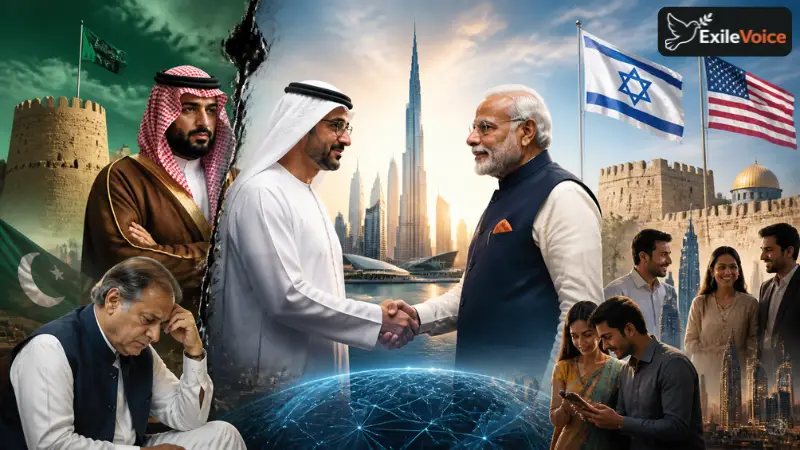
The geopolitical landscape of the Middle East is undergoing a tectonic shift as the United Arab Emirates (UAE) increasingly asserts its strategic independence. For decades, the Gulf Cooperation Council (GCC), formed in 1981, operated under the implicit leadership of Saudi Arabia. However, recent developments indicate that this long-standing hierarchy has fractured. The UAE is no longer content to follow the Saudi lead, opting instead to forge a distinct path characterized by deep technological and security ties with Israel and a burgeoning economic partnership with India.
A critical indicator of this divergence is the UAE’s recent demand for Pakistan to repay $3.5 billion in debt. This move reportedly caught both the Pakistani Finance Ministry and the International Monetary Fund (IMF) off guard, as Abu Dhabi had previously committed to maintaining those reserves until at least 2027. This financial withdrawal is not merely about liquidity, the UAE’s sovereign wealth funds manage over $2 trillion, but is a calculated signal of a change in regional priorities. The UAE is transitioning from a traditional donor state to a strategic investor that demands economic viability and political alignment.
Central to this new doctrine is the UAE's pivot toward Israel and the United States for its primary security architecture. Despite the regional volatility caused by the Iran-U.S. conflict, the UAE has doubled down on its relationship with the West and Israel. This shift is driven by a desire to modernize its economy through travel, investment, and high-level technology, moving away from the fossil-fuel-centric model that historically defined the GCC.
Furthermore, the demographic reality in the UAE underscores its deepening ties with India. With over 4.3 million Indian nationals residing in the Emirates, more than double the Pakistani diaspora, the UAE’s retail, finance, and banking sectors are increasingly integrated with Indian interests. This demographic and economic tilt suggests that the UAE sees its future security and prosperity as being inextricably linked to a new axis of power that includes Washington, New Delhi, and Jerusalem, effectively challenging the traditional Arab-Islamic leadership role of Saudi Arabia.