Recent declarations from Indian defense leadership signal an increasingly assertive posture in regional geopolitics, underscored by substantial military modernization and naval expansion. During commemorative events marking the anniversary of the Kargil conflict, Indian Defense Minister Rajnath Singh delivered sharp warnings regarding cross-border security policies and bilateral relations. The official rhetoric emphasized a zero-tolerance policy toward security threats, asserting that future engagements would focus heavily on territorial disputes concerning Azad Kashmir.
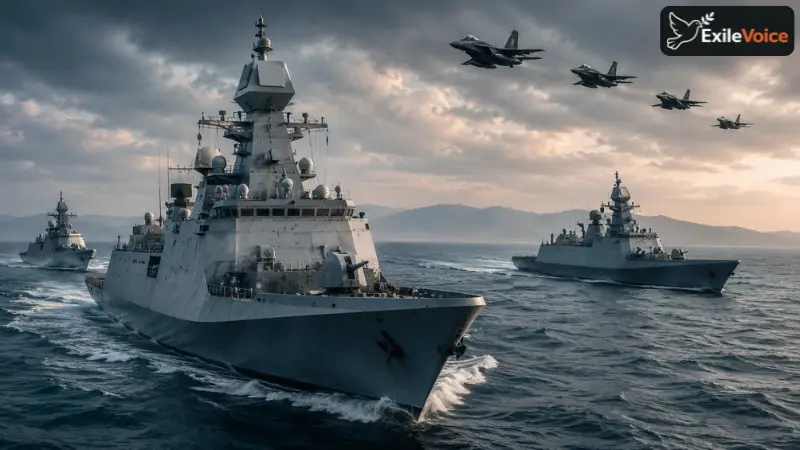
Beyond verbal rhetoric, India is executing a massive naval build-up designed to project power across the Indian Ocean and the broader Indo-Pacific region. The Indian Navy's fleet expansion strategy incorporates the continuous commissioning of advanced stealth frigates and domestic shipbuilding initiatives, aiming for a significantly larger fleet size by the next decade. With a defense budget heavily weighted toward advanced technological integration, anti-drone systems, and naval dominance, New Delhi continues to widen the resource gap in maritime capabilities compared to regional rivals.
Historically, naval superiority played a decisive role in regional conflicts, most notably during the 1971 war where maritime blockades and operations severely impacted logistics and communication lines. Analysts note that while regional defense priorities have traditionally favored land forces and intelligence apparatuses, the modern geopolitical landscape dictates that strategic deterrence increasingly relies on maritime power projection and technological adaptation. The widening disparity in naval investments highlights the pressing need for comprehensive strategic reassessments in response to shifting regional dynamics.