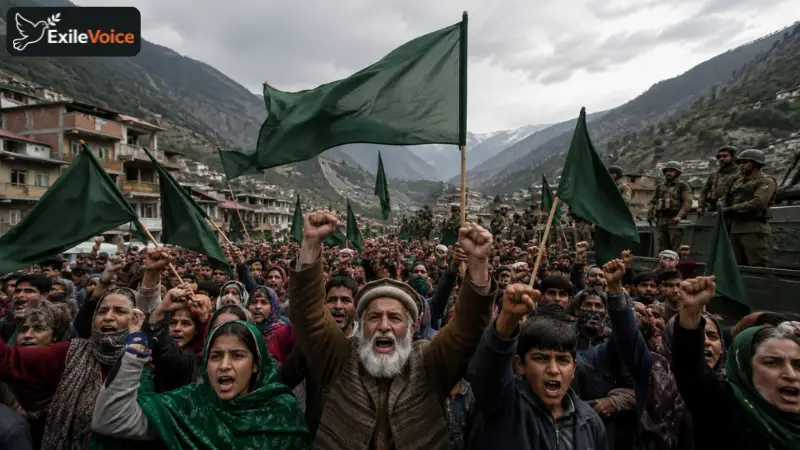
The political landscape in Pakistan-administered Kashmir is experiencing an unprecedented shift, marked by public challenges to the traditional Pakistani administrative narrative. For the first time in nearly eight decades, slogans explicitly demanding independence from Pakistan have gained traction among local populations. This movement, which intensified in mid-2026, has seen thousands of citizens, including women, children, and elders, publicly declare the region as an occupied territory rather than a semi-autonomous part of the state.
The core of this dissent stems from deep-seated grievances regarding economic exploitation, the denial of fundamental rights, and the perceived systemic suppression of local voices. Protesters argue that the region has been treated as a resource hub without adequate local representation or benefit. The state’s response, characterized by the use of force, internet blackouts, and the restriction of essential supplies, has only served to fuel further civil resistance.
International observers have noted the severity of the situation, with official statements from neighboring India labeling the ongoing protests as a direct consequence of decades of administrative failure and exploitation. While Pakistan maintains its traditional stance, the internal pressure from the Kashmiri population is becoming increasingly difficult for the central government to ignore. Political leaders within the region are now organizing under a unified demand for sovereignty, effectively rejecting the status quo that has defined the region since partition.
The implications of this movement are significant. It presents a major internal security challenge for the Pakistani state, which is already grappling with economic instability and regional instability in Balochistan. The refusal of mainstream political actors to address these grievances has led to a vacuum, which is now being filled by grassroots movements advocating for total independence. As these voices become more organized and vocal, the state faces the choice between continued suppression or a fundamental re-evaluation of its governance approach in the region.