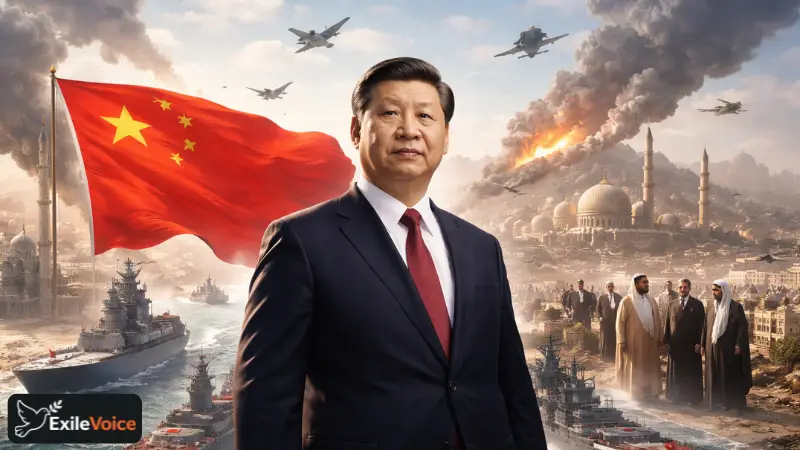
For decades, China has maintained a policy of "non-interference," often remaining a silent giant while Western powers dictated the geopolitical landscape of the Middle East. However, the current global climate has forced a dramatic shift. Xi Jinping’s recent entry into the diplomatic arena, marked by a stern warning issued alongside Arab leaders in Abu Dhabi, signals that the "Red Dragon" is no longer content with being a passive observer. This is not just a change in rhetoric; it is a fundamental shift in China's role as a global power.
President Xi Jinping’s message was clear: the "law of the jungle" will no longer be tolerated in international relations. This serves as a direct diplomatic challenge to Washington, suggesting that international law cannot be applied conveniently or discarded when it doesn’t suit Western interests. For China, this intervention is born out of economic necessity. Approximately 40% of China’s oil passes through the Strait of Hormuz. When tensions rise in the Gulf, Beijing feels the immediate impact on its energy security. Unlike smaller nations that might weather economic fluctuations with domestic austerity, China’s status as the world’s second-largest economy means that any disruption to its energy supply has catastrophic ripples for global markets.
China's newfound assertiveness is also visible on the high seas. Reports indicate that Chinese vessels have begun challenging the maritime blockades recently implemented by the U.S. East Coast authorities. While Washington maintains a narrative of control, the ground reality suggests that Beijing is testing the limits of American maritime dominance. This comes at a critical time as political transitions loom in the United States, with Xi Jinping effectively setting the terms for future engagements: respect and stability over unilateral military posturing.
The entry of China into this conflict changes the calculus for all parties involved. It provides a counterweight to U.S. influence and offers a potential path toward the "cessation of hostilities" that Beijing so desperately desires to protect its economic interests. The era of silent diplomacy is over; China has taken its seat at the head of the table, demanding a world order governed by consistent rules rather than selective enforcement.