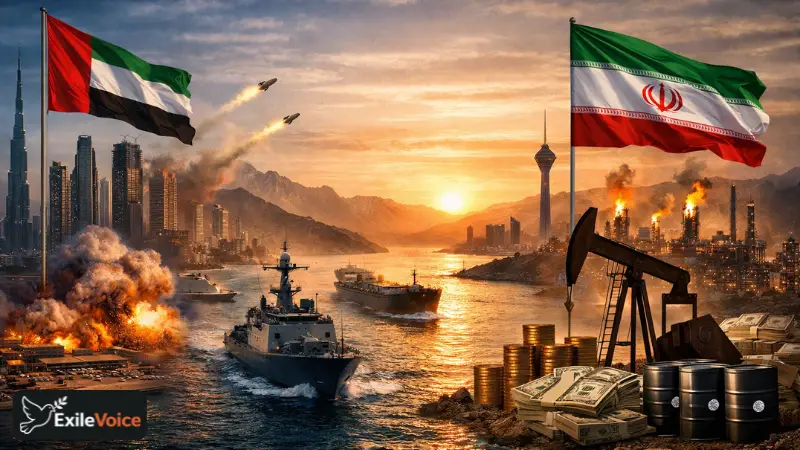
The Middle East is witnessing a seismic shift in power dynamics, fueled by a month-long conflict that has redefined economic and security alliances. At the heart of this transformation is the United Arab Emirates (UAE), which finds itself in an unprecedented existential crisis. While global attention often focuses on the direct confrontations between major powers, the UAE has quietly become a primary target of regional volatility. Recent reports suggest that the volume of missile and drone strikes targeting UAE soil has surpassed those directed at Israel, primarily due to the UAE’s geographic proximity to the Strait of Hormuz, separating it from Iran by a mere 30 miles.
This proximity has turned the UAE into a high-stakes battleground for regional dominance. The economic repercussions are staggering; an economy built on tourism, international investment, and as a global logistics hub cannot sustain the psychological and physical toll of consistent aerial threats. Even a minimal frequency of attacks, as few as two missiles a week, is enough to deter the international investor class and the tourism industry that the UAE has spent decades cultivating. Consequently, the UAE is reportedly pushing for a specialized naval force to secure the Strait of Hormuz, signaling its readiness to take a lead role in regional security, potentially becoming the first Gulf nation to enter a direct military confrontation of this scale following the U.S. and Israel.
Conversely, Iran appears to have emerged from the initial stages of this conflict in a significantly bolstered position. Despite "regime change" rhetoric from Western leaders, the administrative structure in Tehran remains intact, with Mujtaba Khamenei assuming the role of Supreme Leader following the martyrdom of Ali Khamenei. More strikingly, the conflict has inadvertently triggered an Iranian economic miracle. The Iranian currency has seen a massive appreciation, reportedly up to 400% in some markets, as the global perception of Iran’s strategic value shifts.
By effectively controlling the Strait of Hormuz and leveraging its alliance with Yemeni Houthi forces to potentially block the Red Sea, Iran now sits on a lever that controls nearly 32% of the world’s oil supply. This dominance has allowed Tehran to scrap previous discount models; where they once sold oil at a $18 concession, they are now command prices exceeding $100 per barrel. Production has also ramped up to over 2 million barrels per day. As the U.S. signals a potential withdrawal from the conflict within a two-week window, the vacuum left behind suggests a future where Iran’s regional "narrative" and economic standing are more formidable than ever before.