The geopolitical landscape of 2026 is witnessing a seismic shift in the balance of power, one that suggests the end of the unipolar world dominated by the United States. As the conflict involving Iran continues to simmer under a fragile 15-day ceasefire, the international community's gaze has shifted from Washington to Beijing. While U.S. President Donald Trump remains a figure of "predictable unpredictability," characterized by sudden policy shifts and sensationalist rhetoric, Chinese President Xi Jinping is emerging as a composed, calculated, and stabilizing force on the global stage.
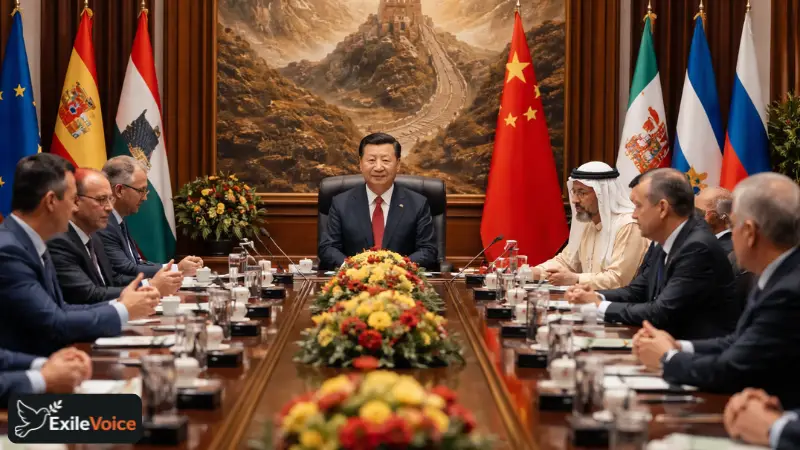
In the past 48 hours, Beijing has become the focal point for world leaders seeking solutions to the ongoing energy and security crises. The diplomatic traffic in the Chinese capital is unprecedented. Prime Minister Pedro Sánchez of Spain, representing one of Europe’s major economies, recently visited Beijing, signaling that European powers now look to China to navigate the current global turmoil. Similarly, the Crown Prince of Abu Dhabi arrived in Beijing to discuss West Asian stability and energy cooperation, moving away from a traditional reliance on American security guarantees. This shift suggests that regional powers no longer believe the keys to their problems lie solely in the Oval Office.
Russia’s Foreign Minister, Sergey Lavrov, has also been active in Beijing, offering energy solutions to China amidst the ongoing naval blockade of Iran. This convergence of European, Middle Eastern, and Russian interests in China highlights a resurrection of the "Middle Kingdom" concept, where Beijing serves as the central hub of global affairs. Unlike the chaotic perception of the Trump administration, Xi Jinping’s persona is viewed as one of imperial calm. For weeks, he remained silent on the naval blockade, but his recent statement labeling the U.S. actions as "chaos" and "the law of the jungle" sent shockwaves through international diplomatic circles.
The New York Times has noted that the U.S. naval blockade of Iran risks destroying the delicate "détente" with China. As President Trump prepares for a high-stakes meeting with Xi Jinping in May, originally delayed due to the Iran conflict, the power dynamics have clearly favored Beijing. China is no longer just a participant in the global system; it is positioning itself as the "balancer of power." This transition is not merely about trade but about the fundamental structure of international relations. The world is watching a transition from a volatile Western leadership to a more stoic Eastern "Imperial Order" that echoes the historical strength of the Chinese empire prior to the 19th-century Opium Wars.