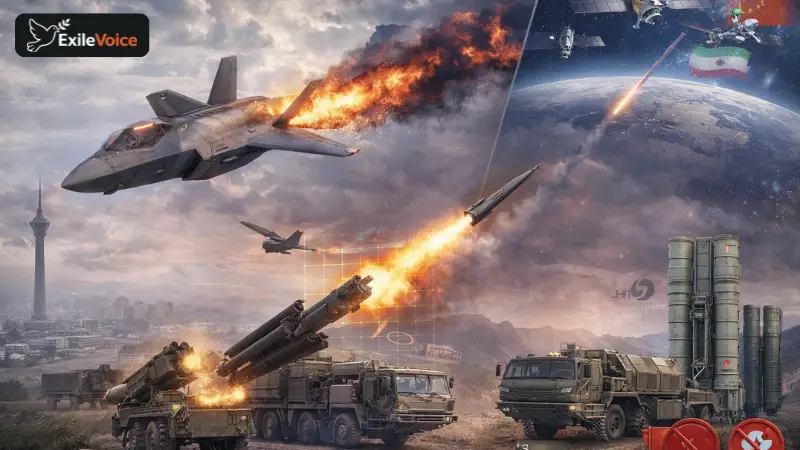
A significant shift in the aerial warfare landscape occurred following reports, confirmed by U.S. Central Command (CENTCOM), that an F-35 Lightning II stealth fighter was hit while operating near Iranian airspace. The F-35, a cornerstone of American and Israeli air superiority, is designed specifically to be "invisible" to traditional radar systems. However, the recent engagement suggests that the technological gap between Western stealth and Eastern detection is closing faster than anticipated.
Analytic insights point to the S-67 anti-aircraft missile system as the likely culprit. Unlike radar-dependent systems that struggle to lock onto stealth profiles, the S-67 utilizes infrared sensors and loitering munition technology. By tracking the thermal signature of the aircraft rather than reflecting radio waves, these "drone-like" interceptors bypass the primary defense of stealth technology. This development marks a "new era" of conflict, as noted by Iranian military officials, where the financial and strategic investment in stealth may face diminishing returns.
Furthermore, the role of Russian and Chinese hardware, such as the S-400 and H-9 systems, remains a critical factor. While Western electronic warfare initially successfully jammed radar-dependent Iranian defenses during the early stages of the 2026 conflict, the integration of newer systems is proving more resilient. The S-400 is theoretically capable of detecting an aircraft from 400 kilometers; however, against stealth targets like the F-35, this window shrinks to a mere 25 to 40 kilometers. This creates a high-stakes "close-quarters" aerial environment where pilots have almost no time to react to incoming missiles.
The strategic pivot of Iran’s guidance systems also deserves professional scrutiny. Following the heavy penetration of GPS-based navigation by U.S. and Israeli forces, Iranian military assets have increasingly shifted to the Chinese Beidou satellite system. This transition provides a layer of operational redundancy and security against Western electronic interference. As the conflict intensifies, the battle for electromagnetic spectrum dominance will likely dictate the survival of high-value assets on both sides.