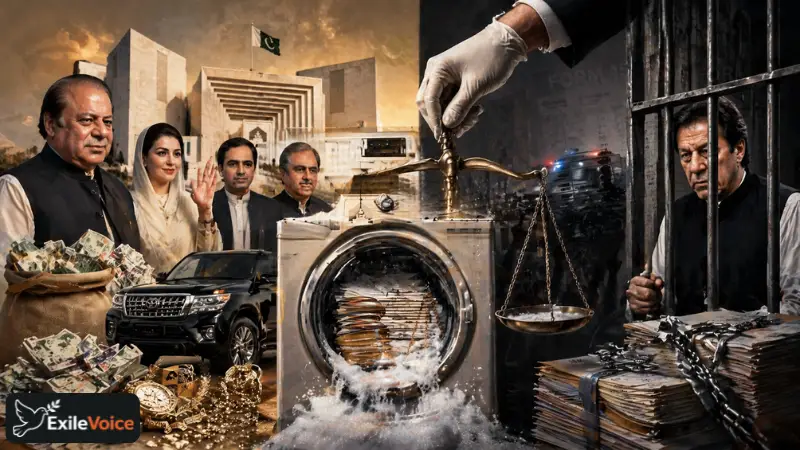
In the complex theater of Pakistani politics, a new term has entered the vernacular to describe the sudden absolution of high-profile political figures from long-standing corruption charges: "Dry Cleaning." This process refers to the systemic clearing of legal hurdles for specific political dynasties, often coinciding with shifts in the country’s power dynamics.
Recent weeks have seen a flurry of activity in the courts of Lahore and Islamabad. Members of the Sharif family, who faced billions in corruption allegations regarding the "Saaf Pani" (Clean Water) company and other infrastructure projects, have seen those cases dissipate. Notable figures including Hamza Shahbaz and Salman Shahbaz, and more recently Rabia Imran, have benefited from what critics describe as a "clearing house" for the elite.
The controversy surrounding these acquittals is magnified by the peculiar nature of the evidence, or lack thereof. History in Pakistani politics shows a recurring pattern where records related to the Sharif family’s corruption cases are often destroyed by "accidental" fires, leading to the collapse of prosecutions. Furthermore, the return of seized assets and security deposits, such as the 70 million PKR recently petitioned for by Maryam Nawaz, signals a total reversal of the accountability measures of the previous decade.
Conversely, the "dry cleaning" service appears strictly selective. While one side of the political aisle sees their cases dismissed, the opposition, most notably Imran Khan, faces a mounting stack of new litigations. The latest "Prohibited Funding" case filed by the FIA seeks to label Khan as the primary accused, a move analysts view as a strategy to keep him incarcerated even if his current sentences are suspended.
This duality in the legal system raises serious questions about the "Rule of Law." When the state’s accountability mechanisms are perceived to be used as tools for political negotiation rather than justice, the social contract is weakened. The "Dry Cleaning" phenomenon ultimately points to a cycle of NROs (National Reconciliation Ordinances) that has plagued the nation for 80 years, where politicians are branded corrupt only to be reinstated as "clean" when the political winds shift.