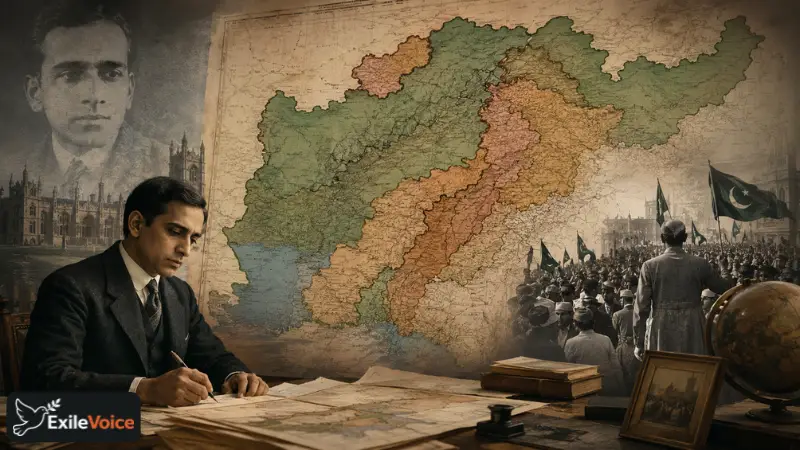
The conceptual origins of Pakistan are often simplified in traditional textbooks, yet the reality behind its founding remains one of the most compelling and overlooked chapters in South Asian history. Choudhry Rahmat Ali, a visionary student at the University of Cambridge, is officially credited with coining the name "Pakistan" in 1933. However, his contribution went far beyond a simple acronym representing the provinces of Punjab, Afghania (Khyber Pakhtunkhwa), Kashmir, Sindh, and Balochistan.
Rahmat Ali’s vision for the region was expansive and radically different from the final political borders established during the partition of 1947. Historical documents, including maps archived in public libraries, reveal that his conceptualization of the homeland included a much larger geographic footprint. His proposals were not merely political suggestions but a total reimagining of the Muslim nationalist landscape. In his writings, Rahmat Ali envisioned a structure that encompassed vast territories, asserting that the partition process was inherently flawed and did not deliver the sovereignty that the nation’s founding goals necessitated.
The tragic reality of Rahmat Ali’s later life stands in stark contrast to his intellectual contributions. Following the creation of Pakistan, his critiques of the political establishment, specifically his dissatisfaction with the scope of the partition and his outspoken views against prevailing leadership, led to his alienation. He was eventually forced into exile by the government of the time, stripped of his assets, and lived his final days in relative obscurity. He passed away in London, ultimately being buried at the expense of the University of Cambridge.
Analyzing Rahmat Ali’s original maps and pamphlets today offers a sobering reflection on the divergence between an imagined ideal and historical reality. His story serves as a reminder that the narrative of Pakistan was not a static, singular path but a complex dialogue of intellectual debate, internal contention, and systemic challenge. Understanding these roots is essential for grasping the complexities of modern-day political discourse, as it highlights how the intellectual foundations of a nation are often reshaped, critiqued, or obscured by the shifting demands of contemporary power structures.