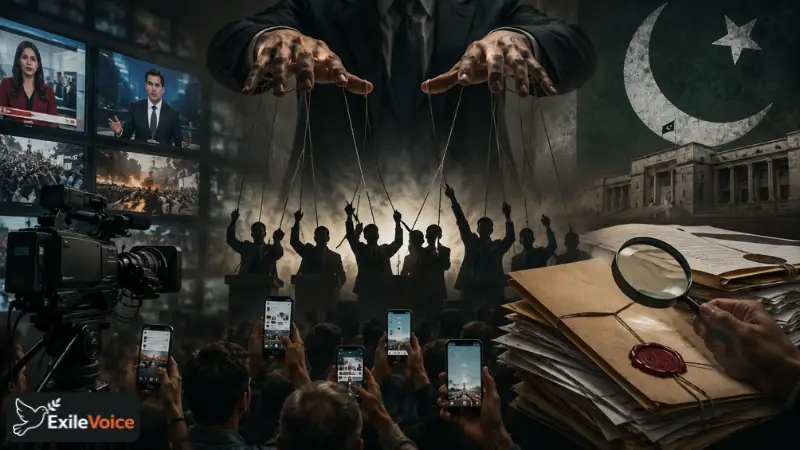
The contemporary media landscape in Pakistan offers a profound study in the sociology of journalism, the degeneration of media ethics, and the systematic manufacturing of public narratives. In an era dominated by rapid information cycles and deep institutional polarization, the line between objective investigative reporting and state-sponsored public relations has become virtually non-existent. The trajectory of senior journalists and political commentators over the past several years reveals a disturbing pattern of behavioral shifts, where media figures routinely construct elaborate narratives on behalf of institutional handlers, only to aggressively backtrack or engage in semantic gymnastics when those narratives are exposed as factually bankrupt. This phenomenon goes beyond simple journalistic error; it represents a structural dependency where information is treated as a commodity for political leverage rather than public enlightenment.
A striking example of this ethical decay can be observed in the shifting journalistic and political stances surrounding high-profile state secrets and diplomatic communications, such as the controversial "Cipher" controversy. During the height of the political transition that saw the removal of the Pakistan Tehreek-e-Insaaf (PTI) government, key political figures and media anchors launched a concerted campaign to delegitimize assertions of external diplomatic intervention. Prominent politicians who had served in senior cabinet positions, including former education ministers, openly shifted their public positions, claiming on mainstream television that complex geopolitical maneuvers were merely "fabricated narratives" designed for domestic political consumption. This admission that political narratives do not require a foundation of truth, but are merely tools to manipulate public perception, underscores a deep cynicism that infects the country’s political and media elite.
This crisis of credibility is further compounded by mainstream media anchors who publicly pledge their professional careers on the veracity of specific reports, only to remain completely silent when those reports are definitively falsified. The phenomenon of the "on-air apology" or a graceful admission of error has been entirely replaced by a culture of defiance and obfuscation. When investigative claims regarding state documents are proven wrong, anchors often pivot to absurd arguments regarding physical formats, such as debating the color of a document rather than its substantive legal weight, in order to distract the public. This refusal to exhibit professional accountability has deeply fractured the public’s relationship with the fourth estate, driving millions of citizens away from traditional legacy networks toward decentralized alternative digital platforms.
Simultaneously, the state apparatus continues to deploy classic counter-intelligence and psychological operations to manage public anger and target specific political entities. A recurring strategy involves the use of highly publicized, state-controlled testimonies from arrested individuals or political defectors, often referred to in Pakistani political jargon as "controlled assets" or tactical leak figures. These individuals are strategically utilized to inject unverified, sensationalist claims into the public discourse, naming opposition politicians in corruption or smuggling scandals to keep them off-balance.
When these narratives are deployed, mainstream networks amplify them without any standard fact-checking or journalistic skepticism. This incestuous relationship between state institutions, compliant politicians, and corporate media networks has turned the public information sphere into a theater of the absurd, where narratives are manufactured, deployed, and discarded based entirely on the shifting requirements of political expediency.