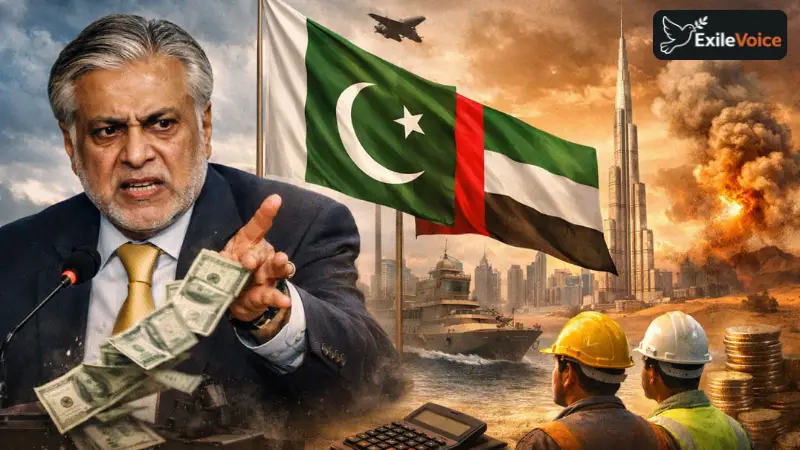
Recent developments in Pakistan’s foreign policy have signaled a precarious shift in its relationship with long-term ally, the United Arab Emirates (UAE). Foreign Minister Ishaq Dar’s recent interactions with journalists have brought to light a growing rift, reportedly centered on the UAE’s demand for the repayment of outstanding debts. Sources indicate that during a briefing, Dar expressed significant frustration over the UAE’s "demands," which allegedly touched upon sensitive regional security issues, including Pakistan’s stance on the Iran-Saudi conflict and the use of Pakistani airspace.
The friction reached a peak when the UAE requested the return of approximately $2 billion in deposits—funds originally provided during the 2019 administration to stabilize Pakistan's economy . Dar’s reported response to "throw the money back" suggests a departure from traditional, quiet diplomacy toward a more confrontational approach. This shift is particularly concerning given Pakistan’s heavy reliance on remittances. The UAE contributes nearly $10 billion annually to Pakistan’s foreign exchange through its labor force . Any prolonged diplomatic hostility could jeopardize the residency and livelihoods of millions of Pakistani workers in the Gulf.
Furthermore, reports suggest that the UAE had sought specific strategic concessions, including access to Pakistani naval assets for ship protection and the potential use of Balochistan for surveillance missions . Pakistan’s refusal to align with these demands, coupled with the aggressive rhetoric from state-aligned commentators, marks a volatile chapter in Middle Eastern diplomacy. As Pakistan navigates this "double game" between regional powers and global giants like China and the U.S., the integrity of its foreign policy remains under intense scrutiny.