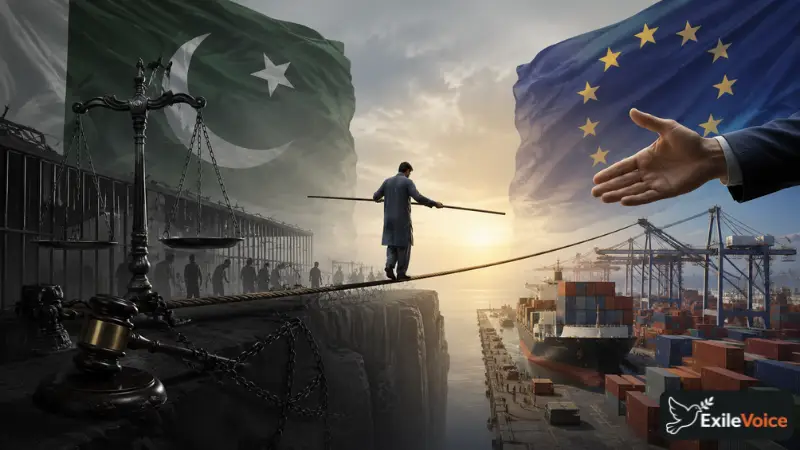
Pakistan’s economic stability is currently facing a precarious juncture as the European Union (EU) raises serious concerns regarding the country's human rights record. As the primary beneficiary of the EU's GSP Plus (Generalised Scheme of Preferences) status, Pakistan relies heavily on this framework for duty-free access to European markets, facilitating billions of dollars in annual exports.
Recent reports from the EU explicitly mention the state’s approach toward former leadership, specifically referencing the imprisonment of former Prime Minister Imran Khan, as well as broader concerns regarding judicial independence and the treatment of minority groups. The EU’s message to the Pakistani establishment is clear: adherence to international human rights standards is not a choice, but a requirement for continued economic preferential treatment.
The potential loss of GSP Plus status could have devastating consequences for Pakistan’s industrial sector, particularly in textiles and apparel, which are central to the nation's export economy. Losing this status would lead to a significant increase in tariffs, rendering Pakistani goods less competitive in the global market. Furthermore, the political instability and reports of state-led crackdowns on dissenting voices are increasingly being scrutinized by international observers.
Economists and trade analysts emphasize that Pakistan must demonstrate a tangible commitment to reform, including the protection of fundamental civil liberties, if it hopes to maintain its standing with the EU. The government faces a difficult balancing act: maintaining its current security-led domestic policies while ensuring that the economic lifelines provided by trade partners remain intact. Failure to rectify these human rights concerns threatens to further isolate Pakistan's economy at a time when it can least afford to lose external revenue.