
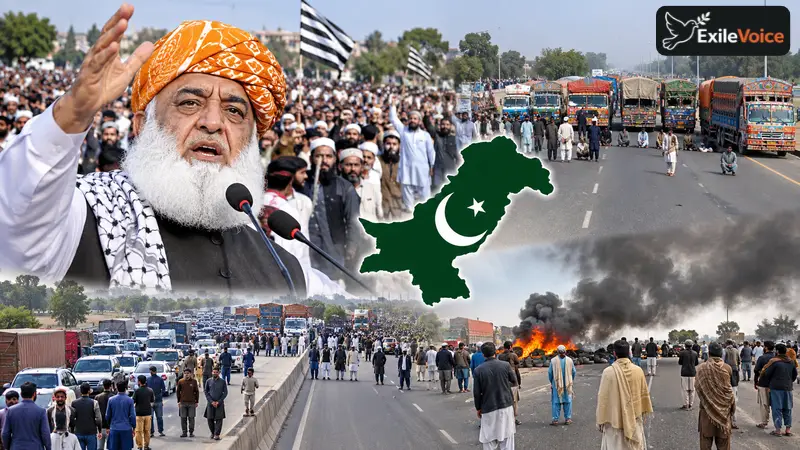
Pakistan experienced widespread highway and motorway disruptions across multiple provinces following a protest call by Jamiat Ulema-e-Islam (JUI) leader Maulana Fazlur Rehman. The mobilization unfolded after authorities in Lahore moved to restrict his travel toward Sargodha, prompting party workers to block major arteries across Punjab, Sindh, Khyber Pakhtunkhwa, and Balochistan.
The sequence of events began when efforts were made to prevent Fazlur Rehman from traveling to Sargodha for a scheduled gathering. Prior to the nationwide call, local authorities in Sargodha issued an entry restriction order invoking colonial-era administrative powers held by a deputy commissioner, alongside Section 144 restrictions. Even after permission to travel was granted once road closures began taking hold, party supporters across various districts staged protests, set up obstructions, and blocked key transit routes.
Reports compiled up to the late afternoon reflected closures or partial disruptions along vital corridors. In Punjab, affected points included sections of the M-2 motorway near Kot Momin, Salam, and Bhera, routes around Chakri, Capital Smart City, and Thalian, the Chashma-Dera Ismail Khan-Mianwali road carrying traffic from Balochistan toward Islamabad, and severe congestion around Thokar Niaz Baig in Lahore. In Sindh, disruptions were reported around the Larkana bypass on the Indus Highway, roads in Naushahro Feroze, the Shikarpur bypass, the Sujawal National Highway, obstructions on the Matiari National Highway, the Jacobabad border route linking Sindh and Balochistan, the Karachi Super Highway, Hub Toll Plaza, and attempts in Tando Allahyar. In Khyber Pakhtunkhwa, closures or blockades were noted on the Peshawar Motorway, the Kohistan Karakoram Highway, the Kohat Indus Highway, Mansehra Main Chowk, the Jamrud-Torkham highway, Gandi Chowk in Lakki Marwat, the main highway in Buner, Karak, and routes connecting Drosh, Chitral, and Peshawar. In Balochistan, disruptions were reported around Bostan Cross, Mughalzai Chowk in Kalat, the Karachi highway in Quetta, the Quetta-Sibi road, Baleeli, Hub, Ziarat, and Chaman.
While the scale and duration of blockades varied by location, ranging from brief stoppages to broader slowdowns or closures on one or both sides of a road, the scale of coordinated street and highway action stood out against a backdrop of subdued street mobilization by other opposition forces since the events of May 9 and subsequent legal crackdowns. Earlier efforts by Pakistan Tehreek-e-Insaf (PTI) to shut down roads or provinces had faced heavy state pressure and internal containment, making the JUI highway closures a focal point of political debate.
Analysts and commentators examining the episode pointed to competing interpretations of how such broad mobilizations occur in Pakistan's political landscape. One perspective questions whether large-scale highway blockades could persist without tacit accommodation or a broader strategic calculation, given how harshly unapproved protests have been handled elsewhere. Another view considers whether shifting alignments among ruling coalition partners, provincial restructuring debates, or external geopolitical pressures on the military establishment could alter bargaining positions behind closed doors. At the same time, observers note that Maulana Fazlur Rehman's political trajectory has consistently been driven by pragmatic interest and tactical leverage rather than rigid ideological alignment, positioning him to extract concessions or expand his footprint in Khyber Pakhtunkhwa and beyond depending on how the standoff evolves.