
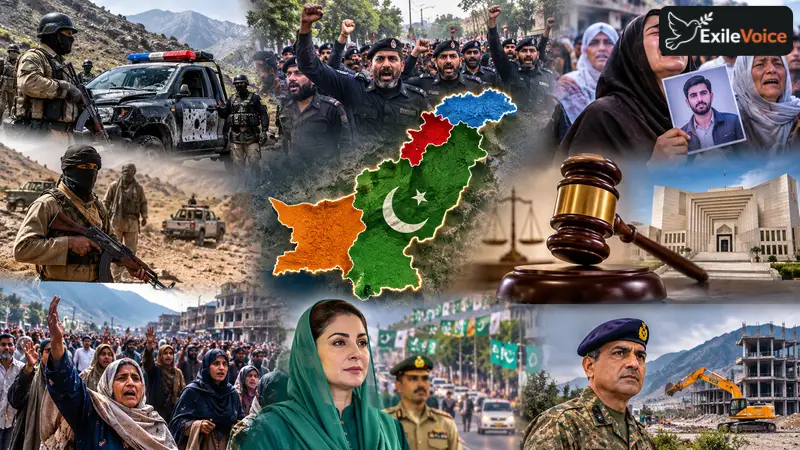
A troubling convergence of security incidents, civil unrest, and contentious judicial and administrative developments underscored deep governance strains across Pakistan's sensitive regions and legal institutions. From militant attacks and police protests in Khyber Pakhtunkhwa to reported abductions in Balochistan, heightened demonstrations in Kashmir, and sharply contrasting court outcomes in Islamabad and Lahore, the week's events pointed to mounting institutional pressure.
In Khyber Pakhtunkhwa, security conditions deteriorated further with an attack on a police vehicle in Lakki Marwat that left multiple police personnel injured. The assault stoked growing frustration within law enforcement ranks, with reports of police personnel in districts such as Bannu and Kohat protesting or preparing strike action over recurring militant attacks on police and questions surrounding security coordination and protection on the ground.
Adding to concerns over civil liberties and press freedom in Khyber Pakhtunkhwa, two journalists from South Waziristan were reported missing from Peshawar after being taken away by unidentified individuals, with difficulties registering a formal first information report. Incidents involving missing journalists and delayed legal recourse continue to draw concern from rights advocates and media observers.
Meanwhile, distressing reports and social media videos emerged from Balochistan claiming that two security personnel had been abducted by militants from the Baloch Liberation Army, complete with identity cards shown on camera. While independent and official confirmation was awaited before treating the footage as verified fact, the circulation of such videos highlighted the persistent security challenge in Balochistan and the anxiety surrounding hostage and abduction claims.
In Kashmir, tensions and public anger have been visibly rising following the killing of a young man, identified as Syed Ehtesham, drawing large funeral gatherings and outspoken protests, including emotional speeches by his sisters and growing street demonstrations involving women and elders. Observers noted a deepening sense of grievance and alienation among segments of the local population, prompting pointed questions about how state authorities characterize and address unrest in Kashmir compared with other regions.
Across the legal and political sphere, contrasting outcomes fueled debate over unequal treatment under the law. In Islamabad, hearings on appeals filed by Imaan Mazari and Hadi Ali Chatta in a barrier removal case were disrupted when the bench canceled the cause list, prolonging uncertainty over their appeals. By contrast, reports highlighted that Rabia Imran, daughter of Prime Minister Shehbaz Sharif, and her husband Ali Imran were acquitted in a corruption or money laundering related case, drawing sharp comparisons from critics and family members of political activists who argue that accountability and judicial relief appear uneven.
At the same time, public attention focused on high profile appearances and administrative appointments. In Rawalpindi, preparations for Chief Minister Maryam Nawaz's visit involved street decorations, repainting of pushcarts, and canceled school trips, even as discussions continued over road closures and public convenience. Elsewhere, reports of a senior military officer being named to head a development committee in Peshawar sparked debate over civil military boundaries and oversight of development funds, set against broader public speeches invoking faith, duty, and national service.
Taken together, these developments reflect a complex environment in which militant violence, regional grievances, contested accountability, and questions of institutional fairness intersect. Addressing these pressures sustainably will require credible rule of law, transparent oversight, and consistent security and governance policies across all regions.