The Pakistani judicial system is currently at a crossroads as it navigates a series of high-profile cases stemming from the events of May 9. A significant breakthrough occurred in Peshawar, where a judge honorably acquitted several Pakistan Tehreek-e-Insaf (PTI) leaders and workers. The court’s ruling was scathing, noting that the cases appeared to be fabricated with no credible evidence, eyewitnesses, or recovery of illicit items from the accused. This decision serves as a critical precedent, highlighting the systematic use of "unnamed" (unknown) FIRs to politically victimize opposition members. Out of the 35,000 individuals reportedly implicated in various cases across the country, many remain in legal limbo, but the Peshawar acquittals signal a potential shift toward judicial independence in the lower courts.
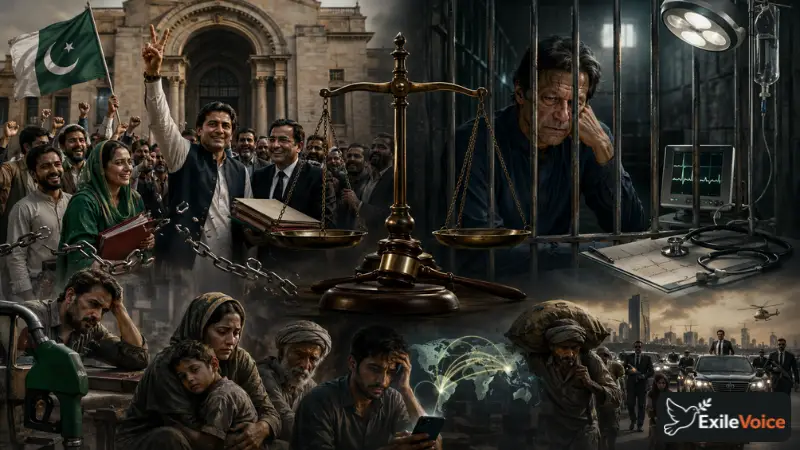
Simultaneously, a new legal front has opened regarding the health and safety of former Prime Minister Imran Khan. His sister, Uzma Khan, has approached the Supreme Court of Pakistan with a petition that does not seek overseas travel, a common privilege granted to past leaders, but rather the right to specialized medical care within the country. The petition is strategically designed to remind the judiciary of the "double standards" in the treatment of political prisoners. It includes newspaper clippings and court orders from the era of Nawaz Sharif’s imprisonment, detailing how the former Premier was granted access to personal physicians and eventually allowed to travel to London on a nominal surety bond.
This legal struggle is taking place against a backdrop of severe economic instability. The State Bank of Pakistan has reported a 7.6% decline in remittances from overseas Pakistanis. While global conflicts and job losses in the Middle East are contributing factors, analysts suggest that political instability and a lack of trust in the current administration are discouraging the diaspora from sending money through official channels. The government’s response to this fiscal gap has been to increase the burden on the domestic population. The Petroleum Minister recently confirmed that the petroleum levy, a direct tax on consumers, is being pushed toward 160 PKR per liter to satisfy IMF requirements.
Furthermore, the government’s "Austerity Drive," which has been extended to June 2026, is being criticized as a superficial measure. While the public is asked to face reduced office hours and limited services, the ruling elite continues to maintain massive security protocols and luxury expenditures. The dichotomy between the "Mahrani" status of certain ruling family members, who recently had 70 million PKR in surety money returned by the courts, and the average citizen facing 50,000 PKR fines for minor regulatory infractions illustrates a deepening social and economic divide.