The current state of Pakistan’s international standing presents a stark paradox: a nation attempting to assert itself as a strategic mediator on the global stage while simultaneously grappling with unprecedented internal fragility. Recent developments in the Middle East, particularly involving Iran, Saudi Arabia, and the United Arab Emirates (UAE), have exposed the thin ice upon which Pakistan’s leadership currently walks. While the state’s establishment seeks to project an image of a "strategic middle power," the reality on the ground is one of profound dependency and systemic failure.
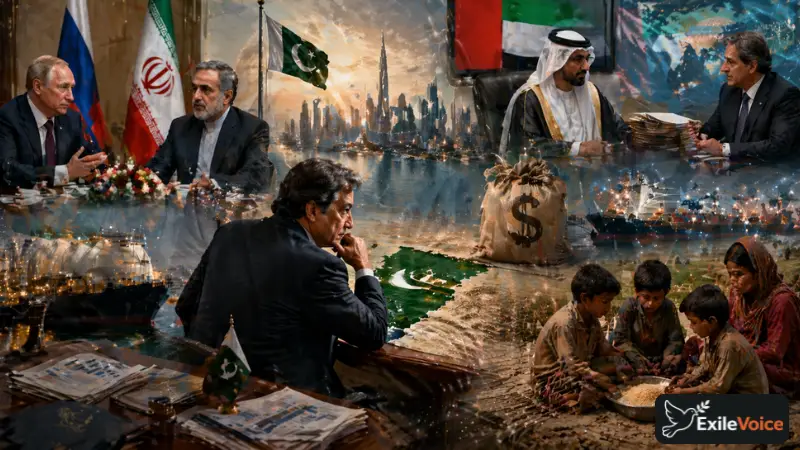
The diplomatic dance between Tehran and Moscow offers a glimpse into the shifting sands of regional power. Iranian officials, led by Abbas Araghchi, have recently made significant visits to Russia, signaling a hardening of the Eastern bloc. Russian President Vladimir Putin’s public acknowledgment of the new Iranian leadership and his messages of support for their "bravery" against Western pressures contrast sharply with the U.S. narrative of regime instability. Notably, Putin’s strategic "spray" of natural sound during meetings served as a calculated message to the West, confirming that Moscow is deeply integrated into the regional security architecture. In this context, Pakistan’s role as a mediator is increasingly scrutinized. While Araghchi acknowledged Pakistan’s efforts, the lack of a strong, unified statement from Islamabad regarding its neutrality has left it vulnerable to accusations of playing both sides.
The fragility of this "neutral" stance was recently tested by the UAE’s demand for a 3.5 billion dollar rollover repayment. This was not merely a financial request but a strategic "warning shot" from Abu Dhabi. Experts suggest that the UAE’s move was a direct response to Pakistan’s perceived tilt toward Saudi Arabia in intra-Arab disputes. The financial realism is harsh: Pakistan remains a debtor nation, and its diplomatic visibility is often mistaken for actual strength. When the UAE, a primary strategic partner for India, flexes its financial muscles, it reminds Islamabad that its "brotherly" ties are secondary to regional power dynamics. The reliance on Saudi Arabia to offset the UAE’s pressure further underscores a cycle of dependency that prevents Pakistan from achieving true sovereignty.
Internally, the cost of these geopolitical gambles is borne by the citizenry. A devastating report by the United Nations has officially categorized Pakistan among the top ten food-insecure nations globally. With over 20 million people facing acute starvation, the disconnect between the elite’s "strategic realism" and the public’s hunger is total. A nuclear-armed, agricultural nation that cannot feed its own children is a walking contradiction. The governance gaps are not the result of a single bad season or climate change alone; they are the accumulation of decades of systemic neglect and economic fragility. As the ruling elite focuses on securing LNG shipments from the U.S. to satisfy international contractors, the fundamental needs of the population remain unaddressed. This internal weakness effectively hollows out any claim to being a regional leader, as a nation that "oppresses its own home" can never command true respect abroad.