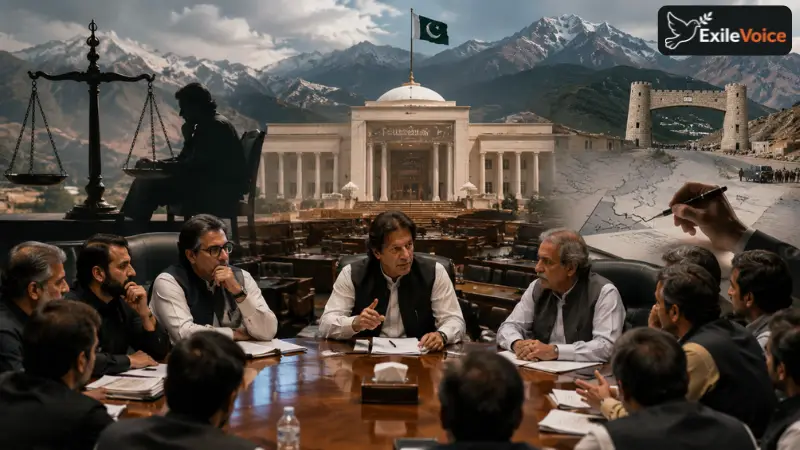
The convocation of the parliamentary party meeting by the leadership of the Pakistan Tehreek-e-Insaf (PTI) in Khyber Pakhtunkhwa, led by senior legislative figures such as Sohail Afridi, marks a critical juncture in the ongoing fiscal and administrative struggle between the provincial government and the federal center. Ostensibly organized to harmonize the party's legislative ranks ahead of the annual budget announcement, the session serves as a foundational platform for deploying provincial constitutional authorities to extract political concessions, ensure administrative autonomy, and challenge the broader economic roadmap imposed by federal managers and international lending institutions.
In mature federal systems, the budget process is frequently utilized by sub-national units as a potent instrument of political leverage. A historical examination of legislative governance reveals that states and provinces routinely leverage their fiscal autonomy, statutory surpluses, or revenue-generating capabilities to alter federal priorities. In the United States, for example, deep-seated disagreements between legislative factions regarding expenditure limits and fiscal priorities regularly culminate in structured government shutdowns, restricting public spending strictly to emergency services. In the context of Pakistan’s current macroeconomic arrangement, which operates under the stringent supervision of an International Monetary Fund (IMF) stabilization program, the fiscal decisions of individual provinces carry disproportionate structural weight.
The federal government’s compliance with international fiscal targets depends heavily on the generation of substantial provincial budget surpluses. This specific vulnerability provides the Khyber Pakhtunkhwa administration with unique strategic leverage. Should the provincial assembly choose to delay the passage of its budget, or deliberately decline to format a surplus budget, the overarching federal commitments to international lenders would face immediate disruption. Experienced governance strategists note that this leverage can be managed with high professional skill to demand critical structural remedies, including the restoration of direct, unhindered medical access and specialized healthcare evaluation for imprisoned party leader Imran Khan, alongside the release of outstanding federal financial arrears owed to the province.
However, the effective deployment of fiscal leverage requires a sophisticated balance between aggressive political posturing and calculated administrative execution. Observers note a persistent tension within the provincial leadership between the impulse to rapidly expedite budget approval to maintain routine governance and the strategic imperative to delay proceedings to gain federal concessions. If the provincial machinery succumbs to legislative haste without securing concrete institutional guarantees, it risks squandering its most effective tool for constitutional resistance, leaving the province vulnerable to continued federal overreach and financial marginalization.
Simultaneously, the administrative friction is exacerbated by ongoing electoral maneuvers and severe procedural constraints in neighboring regions, such as Gilgit-Baltistan, where opposition figures face systematic travel restrictions and unequal access to state protocols compared to ruling coalition members. The formal appeals dispatched by provincial leadership to judicial regulatory bodies, including the Chief Justice of the Supreme Appellate Court of Gilgit-Baltistan, highlight a broader breakdown in institutional neutrality. Ultimately, the outcome of the Khyber Pakhtunkhwa budget session will serve as a definitive indicator of whether sub-national governments can successfully transform technical fiscal processes into viable frameworks for constitutional self-defense and broader political stabilization.