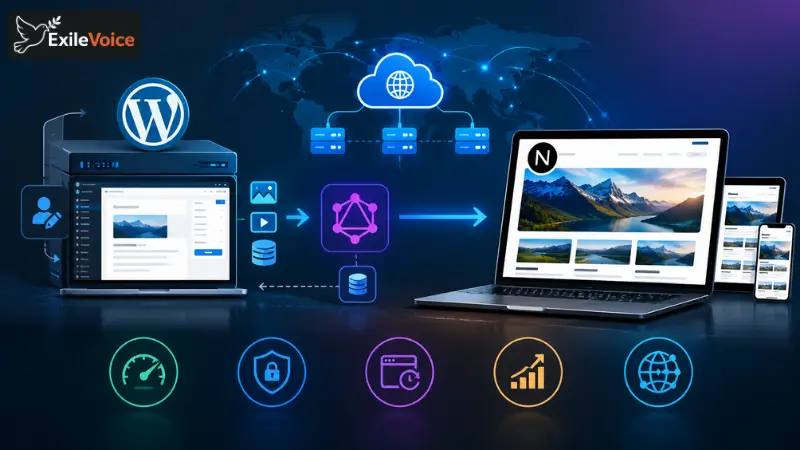
The landscape of modern web development has undergone a fundamental transformation in recent years. Traditional monolithic Content Management Systems (CMS) are increasingly being evaluated alongside decoupled, API-first architecture. Integrating WordPress as a headless content store with Next.js as the front-end framework has emerged as a compelling standard for enterprises and developers seeking optimal performance, enhanced security, and superior user experiences.
Headless architecture separates the backend management system from the front-end rendering layer. In a conventional WordPress setup, PHP templates process request logic and construct HTML markup dynamically upon every visitor request or rely heavily on server-side caching mechanisms. By contrast, a headless configuration utilizes WordPress purely for content creation, media management, and editorial workflows. Content is exposed via structured REST API endpoints or GraphQL queries, allowing external front-end platforms like Next.js to consume and render the data independently.
Next.js provides critical operational advantages when paired with a headless CMS. As a React-based framework, it offers advanced rendering strategies such as Static Site Generation (SSG), Server-Side Rendering (SSR), and Incremental Static Regeneration (ISR). Through Incremental Static Regeneration, developers can generate thousands of static pages during build time while enabling automatic content updates in the background without needing to rebuild the entire site. When an editor updates an article in WordPress, Next.js can revalidate and regenerate that specific page instantly. This capability solves the historical trade-off between the speed of static sites and the dynamic freshness required by busy digital publications.
Performance metrics improve significantly under a decoupled architecture. Monolithic WordPress sites often suffer from bloated database queries, unoptimized plugin asset loading, and server latency. By offloading the presentation layer to Next.js, frontend code execution moves closer to the user through Edge Networks and Content Delivery Networks (CDNs). JavaScript bundles are minimized, images are automatically optimized using Next.js core components, and critical rendering paths are optimized out of the box. Consequently, platforms achieve lower Largest Contentful Paint (LCP) scores, reduced cumulative layout shifts, and overall superior Core Web Vitals performance.
Security posture is also substantially strengthened when decoupling the system architecture. Traditional WordPress installations expose both the admin management panel and database connection interfaces to public web traffic, making them common targets for brute-force login attempts, SQL injections, and cross-site scripting attacks. In a headless deployment, the WordPress backend can be restricted behind isolated internal networks, VPNs, or strict firewall authentication rules. The public front-end static application running on Next.js contains no direct database connections, drastically reducing the attack surface area and neutralizing common exploit vectors.
Implementing a decoupled stack requires careful planning around state management, preview modes, and API payload efficiency. Utilizing GraphQL via the WPGraphQL plugin reduces data fetching over-fetching compared to standard REST endpoints, allowing developers to request precisely the nodes required for a given view. Additionally, setting up draft previews in Next.js ensures that content managers retain their familiar editing workflow without sacrificing the speed and security benefits of modern dynamic rendering. Adopting this decoupled architecture positions digital platforms for long-term scalability and engineering flexibility.