
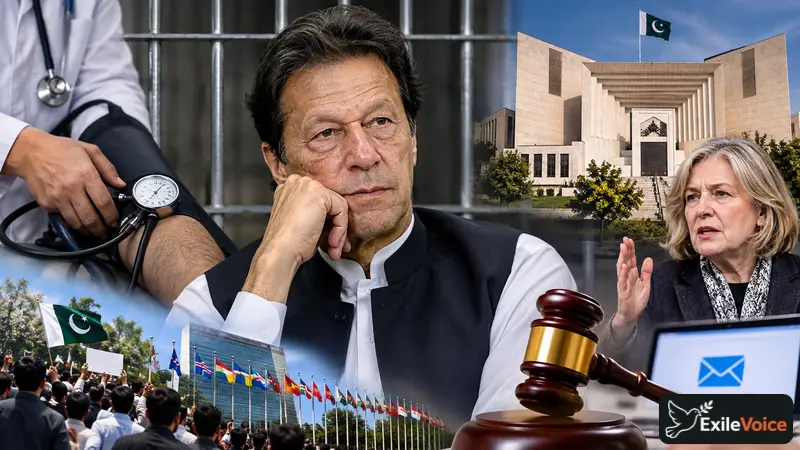
Debate over the health, legal standing, and international advocacy surrounding imprisoned former Pakistani Prime Minister Imran Khan intensified following fresh warnings regarding his medical care and a new wave of overseas campaign activity. In his November 23, 2026 broadcast, Dr. Shahbaz Gill examined a report by The Telegraph highlighting medical warnings about Khan's condition in custody, alongside developments involving Pakistan's Supreme Court benches, journalist Yvonne Ridley's public intervention, and an international email petition campaign.
A central focal point of the coverage is the warning attributed to Khan's personal physician regarding uncontrolled blood pressure and the risk of irreversible cardiac harm if appropriate medical treatment is not administered promptly. The discussion also points to a letter addressed to the Supreme Court of Pakistan and senior judges raising alarms over potential severe health outcomes, including heart attack or brain hemorrhage, if urgent medical care is delayed. Because The Telegraph is a major British publication with established investigative standards, the coverage treats its reporting as a significant development rather than casual commentary, intensifying public scrutiny over custodial healthcare standards and access to specialized medical treatment.
Alongside the medical warnings, the broadcast highlights procedural friction within the judicial system. According to the analysis, a Supreme Court bench positioned to hear matters related to Khan was shifted away from the Islamabad seat to a registry bench in Lahore, creating practical hurdles for proceedings filed at the main seat in Islamabad. The commentary also notes repeated efforts by Khan's sister, Dr. Uzma, to seek judicial attention and implementation of prior orders, underscoring a widening gap between urgent health concerns and timely courtroom relief.
International advocacy has become another prominent dimension of the story. The broadcast highlights remarks by British journalist Yvonne Ridley, who publicly offered to travel to Pakistan and serve out the remainder of Khan's prison term if authorities release him to receive medical care. The analysis connects Ridley's past experience in Afghanistan in 2001 and her subsequent study of Islam to argue that her offer carries symbolic weight, while also pointing to her appeal to the families and female relatives of senior military figures to urge restraint and humane treatment.
Grassroots mobilization abroad has accompanied these high-profile statements. A campaign organized by overseas Pakistanis advocating for the rule of law generated an email appeal addressed to international bodies, including United Nations human rights mechanisms and members of the U.S. Congress, reportedly reaching roughly 135,000 endorsements. Rather than treating the petition as an immediate guarantee of policy change, the commentary frames it as a civic instrument aimed at sustaining international visibility and pressing institutional forums to account for custodial welfare and due process.
Together, these threads illustrate how domestic litigation, custodial health debates, and transnational advocacy have converged around Imran Khan's detention. For observers of Pakistani politics and human rights, the convergence of medical warnings, bench assignments, and overseas pressure shows that disputes over Khan's imprisonment are no longer confined to local courtrooms or party rallies, but increasingly shape diplomatic and public-sphere attention abroad.