
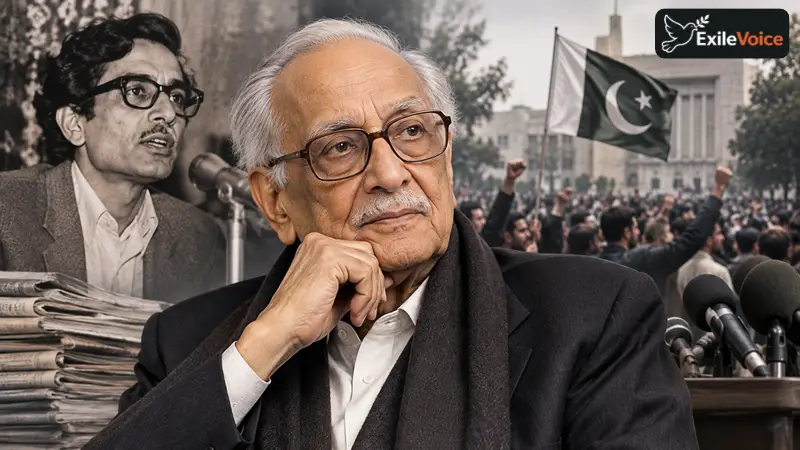
The death of veteran journalist and human rights advocate Syed Hussain Naqvi in Lahore at the age of approximately ninety three marks the close of an extraordinary chapter in Pakistan's media and civil liberties history. Born in Lucknow in the 1930s before moving to Karachi in the 1950s and later settling in Lahore, Naqvi built a career defined by unwavering opposition to authoritarianism across multiple political eras. Throughout his life, he worked with major newspapers, contributed to the Human Rights Commission of Pakistan, and authored his autobiography titled Mujh Se Jo Ho Saka. Unlike figures who accommodated power shifts over decades, Naqvi repeatedly clashed with rulers across regimes, enduring imprisonment under Ayub Khan, Zia ul Haq, and Zulfikar Ali Bhutto while remaining steadfast in his defense of the rule of law and fundamental rights.
Naqvi's final public appearance occurred on November 21 at a book launch in Lahore for Kashmiri writer and activist Ahmad Farhad, whose own trajectory has been closely tied to recent political protests, detention, and street mobilization. Speaking at the event alongside figures such as Salman Akram Raja, Naqvi delivered a stark assessment of political change in Pakistan. He argued that meaningful transformation cannot be achieved through speeches or symbolic gestures alone, stating that genuine change requires street mobilization, sacrifice, and willingness to confront state power despite arrests and casualties. Shortly after leaving the gathering, Naqvi suffered a fatal heart attack and passed away the following morning, turning his final address into a lasting testament to his lifelong convictions.
His passing also exposed sharp divisions within Pakistan's media and political commentary ecosystem regarding how public figures remember dissent and human rights advocacy. Following the news of Naqvi's death, social media posts by prominent commentator Asma Shirazi sharing an older photograph with him drew fierce criticism from critics who accused her of attempting to associate herself with a legacy of resistance while having previously questioned or dismissed the human toll of recent protest movements, including the November 26 events where activists like Ahmad Farhad were present on the front lines. These contrasting reactions highlight a broader fault line in Pakistani public discourse between those who view uncompromising street activism and accountability for state crackdowns as central to democratic survival, and those whose commentary aligns more closely with institutional narratives.
Looking back at Naqvi's early activism, including his student union days at Karachi University where he accepted a three year expulsion to protect fellow Baloch students from losing their education, his biography illustrates a rare consistency between principle and personal cost. For observers of Pakistani politics and journalism, his life serves as a benchmark for independent reporting and civic courage during periods of intense censorship and institutional pressure. Even as media narratives shift and fracture across digital platforms, the questions Naqvi raised in his final speech about the price of political freedom and the durability of authoritarian control continue to resonate across Pakistan's civic landscape.