
Pakistan's rapid transition toward solar energy has drawn international attention as residential and commercial electricity consumers turn to photovoltaic systems at an unprecedented pace. Global observers comparing Pakistan's trajectory to countries such as Germany often point to clean energy momentum, yet a closer look at domestic economic conditions reveals that cost avoidance, rather than discretionary environmental spending alone, has become a primary driver for households across the country.
Historically, solar energy accounted for a small fraction of Pakistan's power mix. Registered solar capacity and adoption figures rose from roughly 2 percent in 2018 to about 5 percent by the end of Imran Khan's government, before climbing to approximately 28 percent over the subsequent three to four years. Industry observers and analysts note that because many smaller rooftop installations go unregistered or are not captured in formal statistics, the true share of solar power generation or self-consumption in Pakistan may sit even higher, potentially between 35 percent and 40 percent.
In economies like Germany, widespread solar adoption was heavily shaped by long-standing environmental awareness, public policy incentives, and feed-in mechanisms that allowed citizens to sell clean electricity back to the grid while supporting climate goals. In the United States, many homeowners rely on third-party financing or lease models where installation companies cover upfront equipment costs and recover expenses gradually through monthly payments offset by lower utility bills. By contrast, households in Pakistan frequently face steep upfront capital requirements for solar panels, inverters, and batteries alongside constrained household purchasing power.
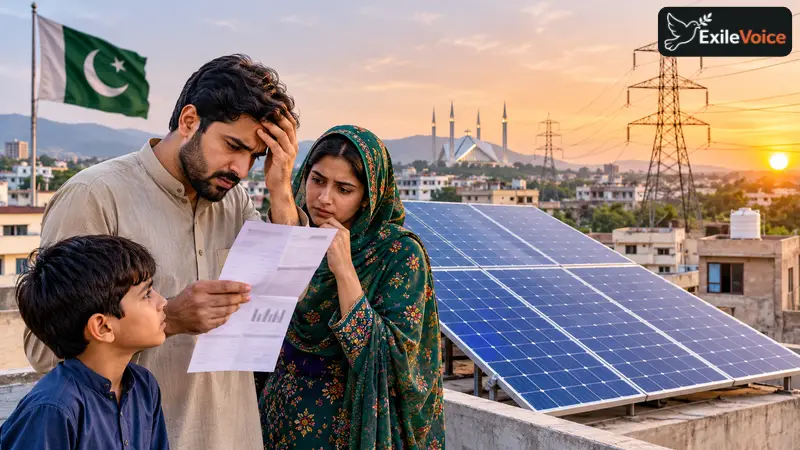
The pressure behind this shift is closely tied to Pakistan's elevated electricity tariffs and broader power sector economics. While neighboring countries in the region see substantially lower per-unit power costs, consumers in Pakistan have confronted high per-unit rates and heavy capacity and independent power producer (IPP) obligations that strain family budgets. For low- and middle-income households, monthly electricity bills have become a severe financial burden, turning off-grid or hybrid solar installations into a survival strategy to cut recurring utility expenses.
At the same time, the rapid expansion of decentralized solar presents structural challenges for Pakistan's conventional grid and utility business model. As more consumers generate their own daytime power and reduce grid reliance, fixed costs and capacity charges must be spread across a narrower base of grid consumers unless tariff structures and net-metering policies are reformed carefully. Policymakers face the delicate task of encouraging affordable clean energy while maintaining grid stability, fair pricing, and sustainable power sector finances.
Ultimately, Pakistan's solar boom reflects a complex intersection of technological affordability, grid strain, and household economic distress. While clean energy adoption reduces reliance on imported fossil fuels and lowers carbon emissions, its real-world impact on ordinary citizens underscores how high energy costs can accelerate infrastructure change out of financial necessity.