
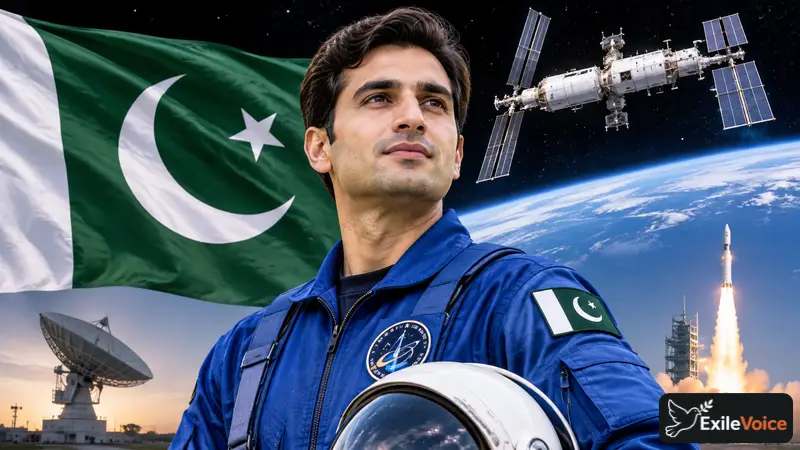
Pakistan Air Force Wing Commander Muhammad Zeeshan has emerged as the central figure in a major aerospace milestone as the first Pakistani slated to travel to space alongside Chinese astronauts under China's space program. For a nation that rarely experiences celebratory breakthroughs in science and technology, the prospect of a Pakistani astronaut entering orbit represents a genuine moment of pride. Regional context adds to the significance of the moment, given that neighboring India achieved human spaceflight milestones well in advance. Collaborating with China's space program opens a new frontier for technical cooperation and national aspiration, placing Pakistan's aerospace personnel at the center of an international endeavor.
Yet beneath the celebration lies a sharp institutional dispute over recognition, institutional lineage, and media framing. According to the analysis presented in the broadcast, official media advisories issued by Inter-Services Public Relations (ISPR) downplayed or omitted explicit references to the Pakistan Air Force, instructing channels to refer to the astronaut simply as Muhammad Zeeshan rather than foregrounding his service branch. While a few outlets aired his rank as Wing Commander, the broader presentation avoided highlighting his Air Force uniform or pairing him with the Air Chief.
This pattern invites comparison with how other military achievements and leadership figures are portrayed in state-aligned coverage. When personnel or initiatives are closely associated with the army leadership or senior command structures, coverage frequently emphasizes senior officers, command hierarchy, and formal meetings with top brass. By contrast, when an accomplishment is rooted in the Pakistan Air Force, institutional credit can become a point of friction. A similar dynamic was recalled from 2019, when Pakistan Air Force pilots shot down Indian aircraft and captured an Indian pilot, sparking widespread public celebration. At that time, official guidance sought to temper excessive media spotlighting of individual pilots, illustrating a recurring tension between public enthusiasm for specific service branches and centralized command narratives.
Crucially, bilateral aerospace and technical cooperation with China predates current command arrangements. Pakistan Air Force officers have worked closely with Chinese partners on technical and aerospace programs over many years, building institutional expertise long before recent leadership transitions. Treating a long-standing Air Force contribution as an extension of personal or singular institutional credit risks obscuring the dedicated engineers, pilots, and technical personnel who built the foundation.
For Pakistan to maximize the strategic value of its first spaceflight participant, transparency and institutional fairness matter. Recognizing the role of the Pakistan Air Force alongside broader national cooperation strengthens morale within the armed forces and ensures that scientific and operational milestones are anchored in factual record rather than selective publicity. Public celebration of Muhammad Zeeshan's selection should therefore honor both the individual achievement and the institutional groundwork that made it possible.