
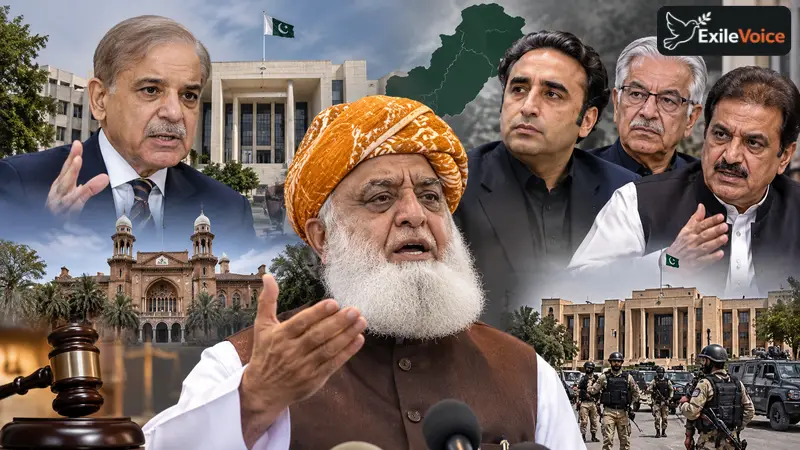
Pakistan's political landscape is experiencing renewed friction across legal institutions, opposition mobilization, and provincial power dynamics, marked by confrontations involving Maulana Fazlur Rehman, high court proceedings, and intensifying pressure in Sindh. In Lahore, Fazlur Rehman was scheduled to address the Lahore High Court Bar Association following earlier appearances at the Peshawar High Court Bar and planned engagements in Karachi. Instead of delivering his address in person, he was stopped outside his residence in Lahore, turning a routine bar association invitation into a flashpoint of political contention.
Despite being prevented from reaching the venue in person, Fazlur Rehman delivered his address remotely using digital technology and camera setup, allowing his message to reach lawyers and broader audiences across the country. Party figures such as Senator Kamran Murtaza highlighted the restriction outside his residence, while television coverage and bar association reactions amplified the standoff. The episode also drew sharp rhetoric from quarters linked to the bar toward the Chief Justice of the Lahore High Court, warning of consequences if the invited guest was not permitted to attend, signaling a volatile shift in courtroom and bar politics compared with recent years of relative quiet.
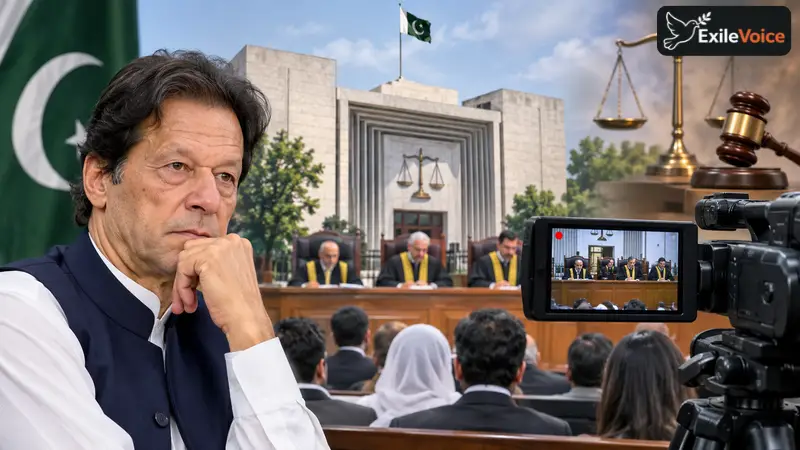
Parallel judicial developments have kept public scrutiny focused on court transparency and consistency. At the Islamabad High Court, legal counsel including Salman Safdar sought the live broadcast of proceedings in the 190 million pound case, also referred to as the Al-Qadir Trust case, arguing that open television coverage would allow citizens to judge the substance of allegations directly. Dr. Uzma Khan similarly called for live broadcast access, drawing a comparison to the televised proceedings surrounding Zulfikar Ali Bhutto's case and urging public visibility before further rulings unfold. Meanwhile, at the Lahore High Court, hearings regarding the detention of Noreen Khan Niazi and Uzma Khan drew criticism because the two had already returned home roughly a week earlier after prolonged family efforts, while other petitions involving Aleema Khanum remained pending without similar resolution.
At the federal executive level, friction among ruling coalition figures has surfaced publicly even as leadership calls for restraint. Prime Minister Shehbaz Sharif urged ministers to avoid trading insults or public disputes, warning that internal bickering harms national progress amid tensions involving figures such as Mohsin Naqvi, Rana Sanaullah, and Khawaja Asif. Yet public remarks continued almost immediately, including commentary by Khawaja Asif pointing to benefits gained by Asif Ali Zardari from constitutional amendments and responses from Bilawal Bhutto Zardari criticizing how amendments were passed.
Simultaneously, developments in Sindh point to mounting institutional pressure around the Pakistan Peoples Party's traditional strongholds. The Sindh High Court rejected pleas to transfer appeals in corruption cases involving amounts below 500 million rupees from accountability courts to ordinary courts, keeping anti-corruption proceedings active. Around the same period, Pakistan Rangers carried out an intelligence-based operation in Memon Goth resulting in over 300 arrests linked to dacoity allegations, while provincial authorities declined to release five Senior Superintendents of Police (SSPs) for transfer to Balochistan. Taken together, these legal, security, and administrative moves indicate a significant realignment of pressure in Sindh that will test political alliances and institutional stability in the weeks ahead.