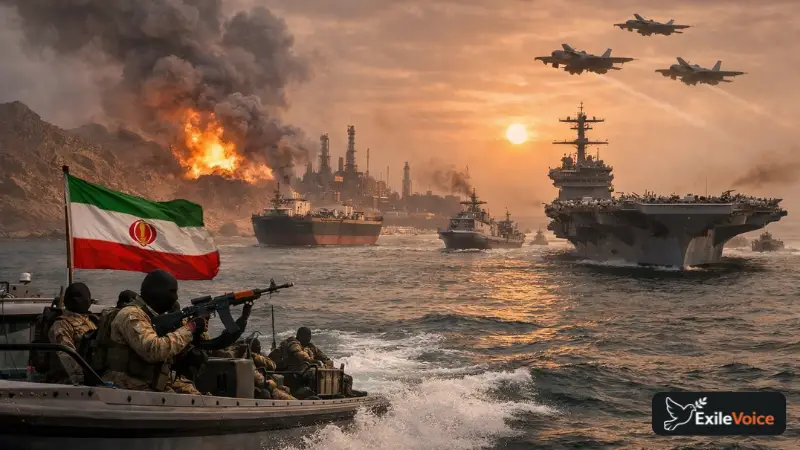
The current geopolitical landscape in the Middle East is marked by a profound sense of "strategic deception." While official narratives from Washington suggest a window for negotiation, the ground realities point toward a significant military escalation. President Donald Trump has recently extended the deadline for Iran to reopen the Strait of Hormuz to April 6, 2026. However, seasoned analysts view this extension not as a gesture of peace, but as a "smoke screen" designed to provide the US and its allies the necessary time to fine-tune their military strike plans.
The crux of the current tension lies in the Strait of Hormuz, a vital maritime chokepoint. The US administration, backed by its Central Command (CENTCOM) and the Pentagon, is reportedly waiting for a categorical assurance that Iran’s retaliatory capacity, specifically its ability to target desalination plants and power grids in the UAE, Kuwait, Bahrain, and Saudi Arabia, has been sufficiently neutralized. Until this guarantee is met, a full-scale assault on Iran’s "power centers" remains a theoretical threat, yet the likelihood of a physical ground operation to seize coastal strips or islands is increasing by the hour.
Adding to the complexity is the role of information warfare. Outlets like the Wall Street Journal are being utilized to broadcast narratives that favor the US-Israel nexus. One such story claims that Pakistani intelligence decoded Israeli messages, revealing a hit list that included Iran’s Foreign Minister, Dr. Abbas Archi, and the Speaker of the Assembly, Baqir Qalibaf. While presented as a diplomatic breakthrough mediated by Pakistan, this narrative likely serves as a veiled ultimatum to Iranian officials: facilitate negotiations with the autonomous units of the IRGC (Islamic Revolutionary Guard Corps) or face assassination.
Furthermore, the "gift" mentioned by President Trump, the passage of eight oil tankers through the Strait of Hormuz under the Pakistani flag, is being used as a test of Iranian control. If Iranian officials indeed facilitated this passage to prove their influence over the IRGC, they may have inadvertently signed their own death warrants by confirming their role as the "address" for future military or political accountability.
The ultimate goal of the US administration appears to be a "War of Choice" where the objective is to destroy Iran’s state structure and then exit the conflict swiftly. However, the global markets remain skeptical. Oil prices have surged to $108 per barrel, and stock indices have dipped, reflecting a fear that a decisive military action is imminent, regardless of the public deadlines.