
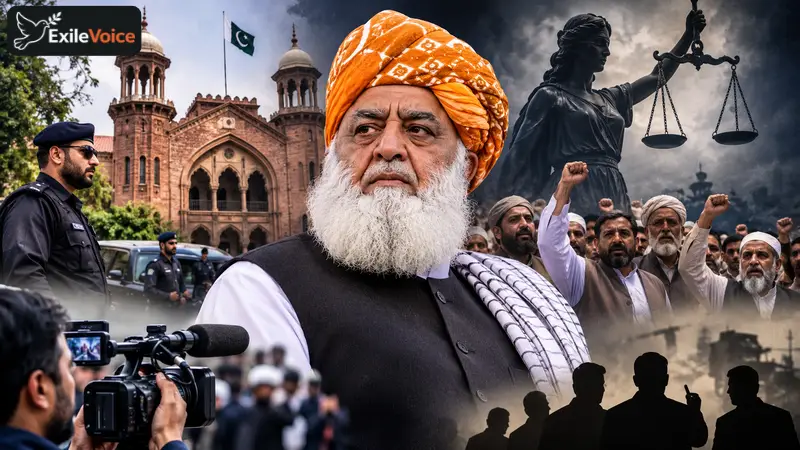
Developments surrounding Jamiat Ulema e Islam chief Maulana Fazlur Rehman have brought judicial oversight, journalistic ethics, and behind the scenes political pressure into sharp focus. Proceedings at the Lahore High Court, where Justice Ali Zia Bajwa sought explanations from Lahore's Capital City Police Officer regarding alleged restrictions or house arrest, spotlighted a striking contrast in how courts treat different political figures. Observers noted that while judicial warnings over potential house arrest of Fazlur Rehman were swift and stern, families and supporters of detained or missing political workers, including figures linked to Pakistan Tehreek e Insaf such as Timur Saleem Jhagra and others reported missing, have long complained of slow or absent judicial relief.
Whether restrictions placed outside a leader's residence are tactical theater or genuine curbs on movement, political analysts point out that blocking a prominent politician outside his home often backfires by amplifying his message. Video addresses circulate widely, media attention intensifies, and the targeted leader gains sympathy rather than fading from view. At the same time, legal observers stress that constitutional protections and due process must apply evenly across all citizens and parties so that judicial intervention is seen as principled rather than selective.
The controversy also sparked an intense debate over reporting standards after journalist Shahzad Iqbal relayed claims attributed to establishment sources describing Fazlur Rehman as a facilitator of militants facing political elimination unless he surrenders. Media critics and commentators argued that simply repeating unverified or threatening assertions from unnamed officials crosses the line from reporting news into amplifying intimidation or unsubstantiated accusations. Robust journalism requires pressing sources for concrete evidence and explicitly stating when claims are backed by proof or when sources fail to provide documentation.
Commentary from senior analysts such as Sohail Warraich further suggested that hardball pressure is aimed at forcing concessions or teaching political actors a lesson rather than pursuing dialogue. At the same time, claims characterizing political rivals in Khyber Pakhtunkhwa as reluctant to oppose militancy drew pushback from supporters who pointed to sacrifices made by party workers and leaders in counterterrorism violence over the years. When commentators blur objective analysis with partisan framing, audiences increasingly turn to independent digital voices and citizen questioning to scrutinize claims.
Ultimately, the clash around Maulana Fazlur Rehman reflects a broader test of democratic norms in Pakistan. Courts must uphold equal protection under the law, journalists must demand evidence rather than acting as conduits for threats or rumors, and political disputes must be resolved through constitutional politics rather than coercion. Without stronger institutional guardrails and stricter editorial rigor, backroom pressure and partisan narratives will continue to polarize public discourse.