
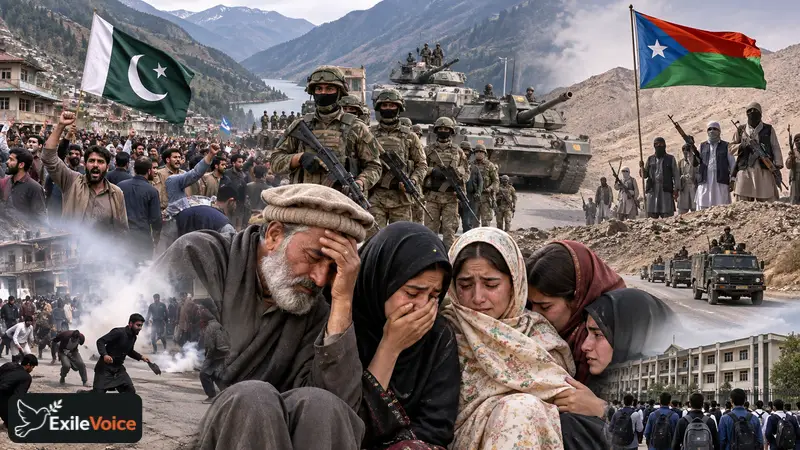
Security tensions in Azad Jammu and Kashmir and Balochistan have reached a volatile threshold as heavy deployments, university closures, and legislative moves in Muzaffarabad intersect with deep seated grievances in southwestern Pakistan. Reports emerging from ground correspondents and regional observers indicate that authorities have cleared student hostels, closed educational institutions in areas such as Poonch and Mirpur, and moved armored vehicles, weapons, and tanks into sensitive zones ahead of a potential large scale operation. In Muzaffarabad, lawmakers have moved a resolution that critics warn could serve as a political cover to legitimize forceful action against protesters, mirroring past patterns in which legislative endorsements were sought to shield security institutions from accountability.
Recent clashes in Rawalakot underscored the fragility of the situation on the ground. Peaceful sit ins and demonstrations have repeatedly met nighttime crackdowns and force, resulting in fatalities and conflicting casualty accounts amid claims that bodies were concealed or accounts were disputed. Human rights advocates and local families point out that when state force strikes unarmed demonstrators or kills family members, the resulting grief and anger rarely remain contained. The commentary highlights the case of a family whose only brother was killed two days earlier, leaving five sisters and a grieving father joining protests in Kashmir. When families lose loved ones without justice or healing, cycles of bitterness deepen and push communities toward hardened resistance.
This dynamic echoes long standing warnings regarding counterinsurgency and drone policies. Opponents of kinetic overreach argue that collateral damage and heavy handed operations do not produce durable peace; instead, every individual killed or alienated can generate ten new adversaries who pick up arms rather than protest empty handed. When armed resistance takes hold, security forces face a far deadlier environment, as seen in recurring attacks and ambushes in restive regions where ordinary soldiers and families bear heavy human costs. Rather than addressing root political and economic grievances with statesmanship, punitive measures and dismissive rhetoric toward regional leaders widen the chasm between citizens and state institutions.
In Balochistan, the crisis has taken on stark human and political dimensions. Statements from nationalist figure Akhtar Mengal questioning the viability of remaining in the union drew sharp pushback and rumors of flight or hiding rather than serious engagement with underlying grievances. Meanwhile, reports from Balochistan highlight the case of Rehan, nephew of lawmaker Rahmat Saleh Baloch, who was studying at an expensive institution in Lahore before returning home on break and joining militant ranks in the mountains. Despite efforts by his family and uncle to stop him, he severed contact and aligned with separatist insurgents. Similar tragedies involving youth from prominent or educated backgrounds illustrate how deep alienation and perceived injustice can radicalize young people across class lines.
Compounding these regional flashpoints are reports of localized pushback and unrest elsewhere in the security apparatus, including strikes by peace committee members in Kohat who complain of rising fatalities amid expanded military oversight and tensions with senior officials. Across these hotspots, a central lesson emerges for policymakers: relying predominantly on coercive force and political maneuvers without credible dialogue, rule of law, and economic fairness risks turning manageable disputes into prolonged insurgencies. Until institutions prioritize reconciliation, accountability, and genuine political representation over unilateral control, instability in Azad Kashmir and Balochistan will continue to exact a heavy toll on civilians and security personnel alike.