The recent death of Pakistan Air Force (PAF) officer Group Captain Asim Tariq in Islamabad has sparked a wave of confusion, skepticism, and intense public debate. While initial reports framed the incident as a tragic act of bravery, where the officer was allegedly killed while intervening in an abduction attempt, subsequent visual evidence and forensic questions have cast significant doubt on the official narrative.
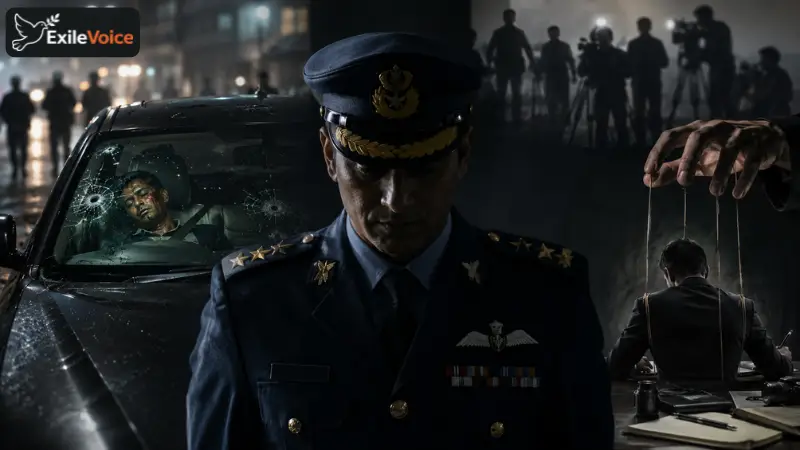
According to the preliminary reports provided to the media, the incident involved a suspect, identified as Saad Abbasi, who was allegedly attempting to abduct a woman on a motorcycle. Group Captain Tariq, it was claimed, intervened to stop the abduction and was shot by the suspect. However, images from the scene show the deceased officer in the driver's seat of his car, wearing his seatbelt.
Critics and analysts have pointed out the obvious contradictions in this version of events. If the officer had stepped out of his vehicle to confront the kidnapper, how did he end up dead in the driver's seat, still buckled in? The physical evidence suggests a narrative that does not align with a spontaneous intervention or a roadside confrontation. This discrepancy has led many to believe that the official account is incomplete or deliberately misleading.
Beyond the forensic inconsistencies, the incident has highlighted the heavy-handed nature of information management regarding military personnel. Sources suggest that high-ranking officials from the military’s public relations wing exerted significant pressure on media outlets to follow a specific narrative. Reporters were reportedly reprimanded for publishing information about the death without prior clearance and were instructed to use specific honorifics like "Shaheed" (martyr) in all coverage.
This aggressive approach to controlling the news cycle suggests that the case of Group Captain Tariq is not just a standard criminal investigation but a sensitive state matter. The incident has left a void where the truth should be, and the vacuum has been filled with speculation.
Some observers have even questioned whether there is a more sinister, international dimension to the tragedy, citing past instances of mysterious killings within Pakistan that have been blamed on external intelligence agencies. While these remain speculative, the fact that such theories are gaining traction is a testament to the lack of transparency surrounding the incident. Until a transparent, independent investigation is conducted and the CCTV footage is made public, the death of Group Captain Asim Tariq will remain a symbol of the opacity that continues to define security and criminal reporting in Pakistan.