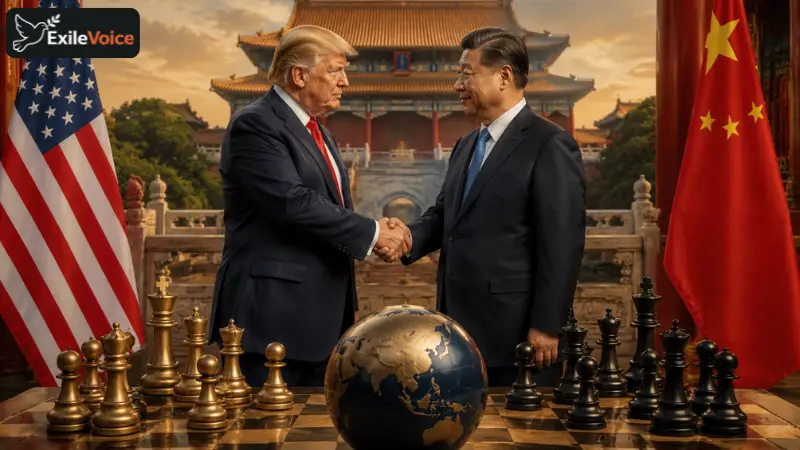
The geopolitical landscape underwent a tectonic shift following the conclusion of US President Donald Trump’s highly anticipated two-day summit in Beijing with Chinese President Shi Jinping. The diplomatic engagement, which involved nearly twenty hours of trans-Pacific travel, has left international analysts, defense experts, and major news outlets scrambling to interpret its long-term outcomes. While initial expectations focused on aggressive bargaining strategies, the emerging consensus among editorial boards indicates a profound transformation in how Washington intends to navigate its relationship with its primary global competitor.
According to deep-dive assessments published by leading global publications, the summit represents a stark departure from the adversarial, hawk-infused rhetoric that characterized the opening of the current administration's second term. Instead of extracting concrete concessions on the foundational "Three Ts", Trade, Technology, and Taiwan, the engagement concluded with a visible tone of conciliation from the American delegation. This shift is being widely characterized by political scientists as a "learning curve" climax, forced by the economic realities of the previous year's trade friction. The structural roots of this diplomatic pivot lie in the limits of economic leverage. China remains uniquely positioned as the singular global power that effectively countered Washington’s unilateral tariff and sanction regimes with its own robust counter-measures, particularly concerning rare earth metals and supply chain restrictions. Unlike European allies or traditional Commonwealth partners who historically adjusted to shifting American trade paradigms, Beijing's retaliatory posture exposed deep vulnerabilities within domestic industrial sectors, prompting a fundamental reassessment of bilateral engagement.
A critical dimension of this summit was the masterful execution of personal diplomacy by President Shi Jinping. Breaking away from rigid historical protocols, where heads of state engage in brief, formal bilateral sessions before delegating secondary cultural tours to vice-presidents or foreign ministers, the Chinese President personally accompanied the American leader throughout the entirety of the two-day visit. This included unprecedented access to the highly restricted Imperial Secret Garden, a location historically reserved for top-tier leadership. This strategic deployment of prestige and hospitality successfully managed interpersonal dynamics, cultivating an atmosphere of mutual respect that effectively sidelined highly contentious issues.
The tactical concessions made during the trip were underscored by remarkable operational security measures. The entire American delegation reportedly left their primary communication devices and smartphones in Anchorage, Alaska, opting for restricted burner devices to mitigate advanced electronic surveillance capabilities. Upon departure, a highly visible public screening of diplomatic gifts took place at the Beijing capital airport—a move viewed as an unnecessary display of institutional distrust. Yet beneath these surface-level frictions, the broader policy shift is undeniable. The administration completely bypassed public mention of the Taiwan sovereignty dispute and accepted a revised framework for aerospace procurement that failed to meet initial baseline expectations.
Ultimately, the Beijing summit marks a milestone where China effectively asserted operational parity within global power dynamics. The Pentagon's annual unclassified intelligence assessments continue to warn of Beijing's strategic objectives: pushing Western naval presence out of the Western Pacific, encircling Taiwan, expanding maritime claims in the South China Sea, and accelerating cyber capabilities. However, Washington's response has fundamentally changed. The administration is no longer attempting to contain these challenges through aggressive decoupling; instead, it is adopting a paradigm of competitive coexistence, acknowledging that managing the modern global economy requires a functional partnership with Beijing.