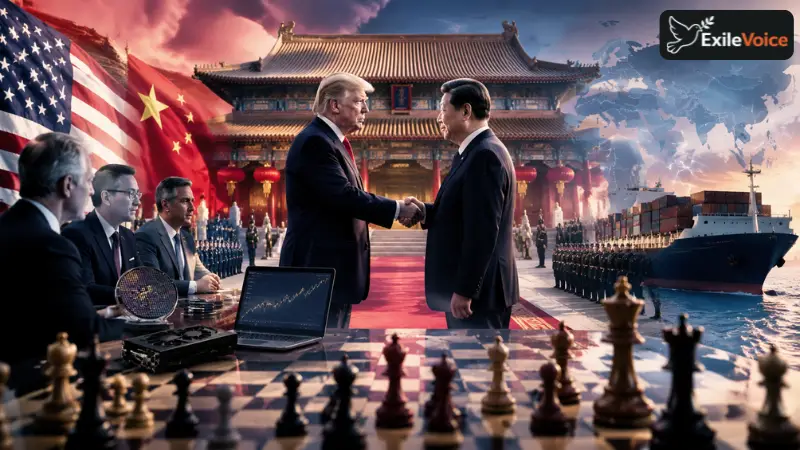
The recent high-stakes bilateral trade summit in Beijing between U.S. President Donald Trump and Chinese President Xi Jinping has concluded, leaving behind a complex web of geopolitical questions and strategic recalculations. Dubbed by Chinese state media and diplomatic circles as the beginning of a fresh structural paradigm, Beijing officially labeled this new relationship as "Constructive Strategic Stability." However, beneath the polished diplomatic jargon lies a hard-nosed game of chess where China appears to have executed a masterclass in asymmetric diplomacy, leaving American interlocutors with empty rhetorical victories while retaining solid strategic ground.
Throughout the intense 48-hour visit, President Xi Jinping successfully outmaneuvered the American delegation by maintaining an air of overwhelming hospitality that masked a rigid refusal to yield on core economic and geopolitical priorities. Trump’s visit, characterized by brief moments of cordiality and heavy media optics, yielded little in terms of structural concessions from Beijing. While the American president touted the trip as a historic engagement, seasoned diplomatic observers noted how efficiently the Chinese state apparatus managed the visit. Almost immediately upon the conclusion of formal talks, the prompt removal of the red carpet and the quick departure of the American delegation signaled that Beijing was eager to close the chapter and solidify its gains.
A particularly telling subplot of the summit centered around regional security and Middle Eastern policy, specifically regarding Iran. Despite aggressive posturing from sections of the U.S. state apparatus and Secretary of State Marco Rubio, who insisted that Washington and Beijing were aligned on international security threats, the topic of Iran was conspicuously minimized. Trump returned to Washington without securing concrete commitments from President Xi to tighten the economic squeeze on Tehran. Instead, the final statements merely reiterated a broad consensus on maintaining freedom of navigation through the Strait of Hormuz and preventing explicit nuclear proliferation, a status quo that functionally acts as a victory for Iran by ensuring it did not become a target of a joint U.S.–China diplomatic offensive.
Nevertheless, the summit was not entirely devoid of commercial outcomes. A select group of American corporate titans managed to secure key concessions. Major U.S. technology firms, including the semiconductor giant Nvidia, managed to retain critical avenues of access to the vast Chinese marketplace, avoiding the most severe outcomes of an immediate trade decoupling. Similarly, top executives from major financial services, such as Visa, made significant inroads during peripheral discussions. With approximately 10 billion debit and credit card accounts active within mainland China, securing stable market access remains an existential priority for American financial infrastructure providers.
Ultimately, the optics of the trip exposed an underlying asymmetry in contemporary superpower diplomacy. While American strategy relied heavily on personalized interactions, executive flair, and spontaneous public statements, China's approach was institutional, deliberate, and highly calculated. By framing the future of bilateral ties under the banner of "Constructive Strategic Stability," Beijing has established a broad, ambiguous diplomatic framework that allows it to project global responsibility while continuously checking American influence across the Indo-Pacific region.