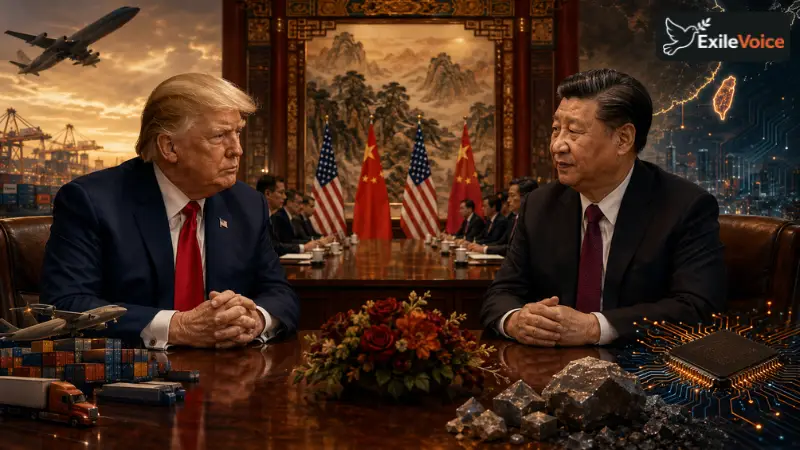
The global stage was set in Beijing as U.S. President Donald Trump engaged in a marathon meeting with Chinese President Xi Jinping. Spanning over two hours, the summit at the Great Hall of the People was characterized by a veneer of warmth and mutual respect, yet underscored by the cold reality of shifting power dynamics. While Trump employed his signature style of public flattery, calling Xi a "great leader" and a "master decision-maker", the underlying agenda revealed an American administration navigating a position of relative strategic disadvantage.
A central pillar of the discussion revolved around the critical supply chain of rare earth minerals and advanced technology. Trump’s delegation, notably including Elon Musk, Tim Cook, and Nvidia CEO Jensen Huang, highlights the desperate need for American tech giants to secure a "free flow" of materials essential for the AI revolution. China currently holds the upper hand in this sector, having previously imposed restrictions that threatened global semiconductor production. Trump is seeking a permanent lifting of these bans in exchange for significant Chinese purchases of American agricultural products and Boeing aircraft.
However, the warm optics were countered by stern warnings from the Chinese side regarding Taiwan. Official readouts from Beijing indicate that President Xi issued a "dangerous" warning, asserting that any mishandling of the Taiwan issue could lead to uncontrollable conflict. This highlights the "red line" that China refuses to negotiate, even as it engages in transactional diplomacy regarding trade and the Middle East.
On the Middle Eastern front, Trump is pressuring China to use its influence over Iran to reopen the Strait of Hormuz. While Secretary of State Marco Rubio frames this as a necessity for China's own energy security, analysts suggest that Beijing is well aware of its leverage. China has successfully bypassed naval blockades to secure its oil in the past, and it views Trump’s requests as a sign of American overextension. The summit proves that while Trump is a master of "the art of the deal," the cards in the 2026 geopolitical deck are increasingly held by Beijing.
Furthermore, the domestic reception of this visit in the U.S. remains polarized. Media outlets like the New York Times and Washington Post suggest that Xi "doesn't need a deal" with Trump, given China’s robust economic positioning. The presence of high-profile CEOs suggests a "business-first" approach, but the geopolitical concessions demanded by China in the South China Sea and Taiwan may prove too costly for the U.S. to accommodate in the long term.