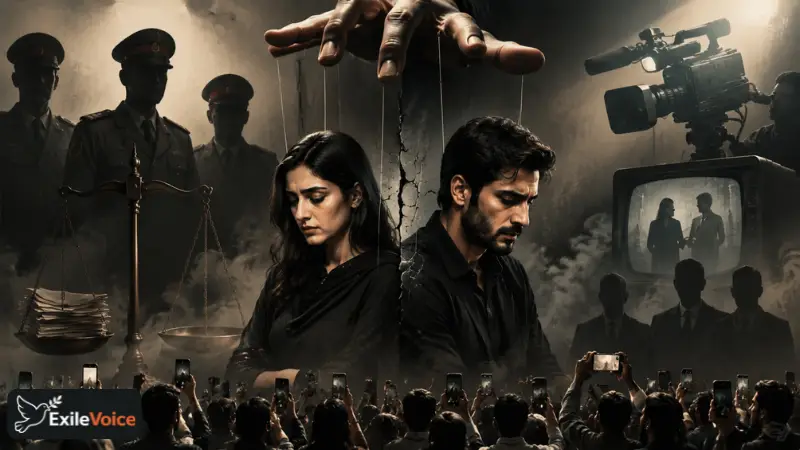
The delicate intersection of arts, entertainment, and national politics in Pakistan has taken an alarming turn, surfacing deep-seated concerns regarding the weaponization of state apparatuses to intimidate public figures. Recent state actions targeting prominent television personalities Sarah Khan and Muneeb Butt have brought institutional overreach into sharp focus. The controversy ignited when the state apparatus, processing a high-profile narcotics investigation involving an alleged drug trafficker named Anmol (popularly known as Pinky), selectively leaked names from an alleged client list of over 800 individuals. Strikingly, out of hundreds of prospective names, the investigative findings broadcast to the public prominently featured only two: Sarah Khan and Muneeb Butt. This targeted exposure has triggered widespread condemnation from civil society and political analysts, who view the leaks not as an objective law enforcement breakthrough, but as a calculated maneuver of institutional character assassination designed to penalize public figures for their political expressions.
To comprehend the severity of this development, one must examine the baseline motives driving these state-sponsored smear campaigns. Analysts point out that Sarah Khan, an internationally celebrated television actress with a massive global and domestic following, had previously voiced strong, unequivocal political opinions during public interviews. Specifically, her public declarations supporting the narrative of former Prime Minister Imran Khan and her candid assessment that alternative political leadership lacked authentic substance placed her directly in the crosshairs of the ruling establishment. Similarly, Muneeb Butt, an influential young actor, crossed an invisible red line during the February 8, 2024, general elections. Butt did not merely express passive political preferences; he actively filmed and documented discrepancies at polling stations, showing raw discrepancies between Form 45 and Form 47 directly to his substantial social media audience. By bringing structural transparency issues to light and validating the narrative of widespread electoral manipulation, Butt transformed himself from a mainstream entertainer into a threat to the state-sanctioned political status quo.
The strategic timing of these revelations points to a broader, more systemic methodology deployed by administrative and security factions within the country. Observers note that leaking unverified investigative details is a classic coercive tool used to enforce absolute conformity across Pakistan's cultural and media landscapes. By controlling major broadcasting networks, establishing specific entertainment channels, and exercising deep administrative leverage over veteran networks like Hum TV, institutional actors have constructed a system where the livelihood of artists is entirely contingent on political compliance. When an artist deviates from the approved narrative, the state's apparatus can be deployed to dismantle their public reputation, compromise their commercial viability, and effectively terminate their careers. This dynamic forces a vast majority of the country's cultural icons, sports figures, and intellectuals into structural silence or forced capitulation, neutralizing their potential to shape public sentiment in opposition to the state.
The selective targeting of Khan and Butt stands in stark contrast to how the current administrative setup treats individuals aligned with its own institutional objectives. While independent-minded artists face public defamation based on unverified investigative claims, individuals serving as state proxies or media mouthpieces are routinely rewarded with prestigious civil decorations, such as the Sitara-i-Imtiaz and Tamgha-e-Imtiaz. This stark disparity was recently highlighted by international media reports, including detailed investigations in Scandinavian press, exposing instances where individuals facing substantial financial fraud allegations abroad were flown to Pakistan to receive top-tier state honors. This institutional practice transforms national awards from symbols of genuine civic excellence into tools of political patronage and reward for media compliance.
Confronting this wave of administrative high-handedness requires a fundamental shift in how civil society engages with and protects its cultural representatives. Because traditional legal protections and institutional checks are compromised within the current political paradigm, the primary line of defense for targeted individuals shifts directly to the public sphere. Social media mobilization, targeted consumption of independent artistic content, and public expressions of solidarity serve as vital countermeasures against state-sponsored defamation. By actively elevating the voices of persecuted artists and refusing to internalize manufactured scandals, the public can dilute the efficacy of coercive state leaks. Ultimately, the preservation of an independent cultural space is intrinsically linked to the broader struggle for constitutional supremacy, highlighting that when the rule of law is compromised, no sector of society, including the arts, remains insulated from authoritarian overreach.