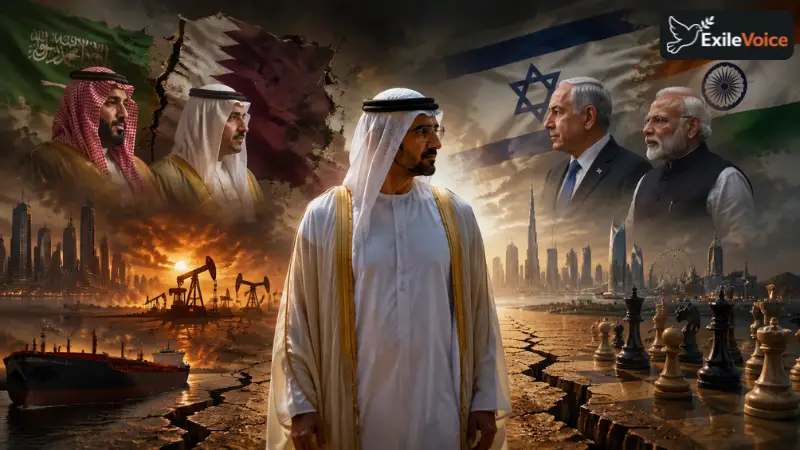
A major institutional rift is developing across the Arabian Peninsula, threatening to permanently alter the security and economic architecture of the Middle East. Intelligence reports and diplomatic leaks, highlighted by major financial news outlets like Bloomberg, indicate that the United Arab Emirates (UAE), led by President Sheikh Mohammed bin Zayed Al Nahyan, is experiencing profound strategic friction with its historical partners within the Gulf Cooperation Council (GCC). This geopolitical divergence stems from an aggressive, unilateral foreign policy stance adopted by Abu Dhabi that has alienated its closest neighbors, most notably Saudi Arabia and Qatar.
According to senior diplomatic sources, the UAE actively lobbied Saudi Arabia’s Crown Prince Mohammed bin Salman and the Qatari leadership, headed by the Al Thani dynasty, to form a joint military and intelligence front aimed at launching coordinated offensive operations against Iran. This audacious proposal was met with a firm and immediate refusal from both Riyadh and Doha. Recognizing the catastrophic economic and security risks that a direct hot war with Iran would bring to the region, Saudi Arabia and Qatar chose to prioritize de-escalation and sovereign diplomacy. This explicit rejection left the UAE isolated, forcing Abu Dhabi to execute limited counter-strikes and asymmetric maneuvers independently, exposing a severe lack of strategic consensus at the very top of the Arab Gulf.
This security fracture has directly spilled over into global energy politics, leading to institutional instability within the world’s most powerful oil cartel. Following prolonged disagreements over production quotas and long-term economic diversification strategies, rumors are intensifying that the UAE is seriously considering terminating its membership in OPEC. Abu Dhabi has long felt constrained by Saudi-mandated production caps that hinder its ability to maximize immediate liquid capital generation to fund its domestic transition plans. Analysts suggest that an exit from OPEC could trigger a domino effect, potentially leading to the UAE completely severing its ties with the GCC, an institution that has formed the bedrock of Arabian geopolitical unity for nearly half a century.
In a desperate bid to counter its growing isolation within the Arab world, the UAE has doubled down on alternative international alliances. Abu Dhabi has significantly deepened its security and economic framework with Israel, moving far beyond the foundational terms of the Abraham Accords. Simultaneously, the Emirati leadership has aggressively courted New Delhi, culminating in major bilateral summits aimed at linking Indian technology and human capital with Emirati sovereign wealth. By pivoting sharply toward a non-Arab security axis involving Israel and India, the UAE is attempting to insulate itself from the political blowback of its fracturing relations with Riyadh and Doha.
However, this strategy carries immense long-term liabilities. By directly antagonizing Iran without the backing of a unified Gulf coalition, and by alienating the traditional powerhouse of Saudi Arabia, the UAE has rendered its domestic infrastructure vulnerable to asymmetric security threats. The institutional unraveling of OPEC and the potential collapse of the GCC format signal a new era of hyper-competition in the Middle East, where historic alliances are discarded in favor of volatile, transaction-based security arrangements.