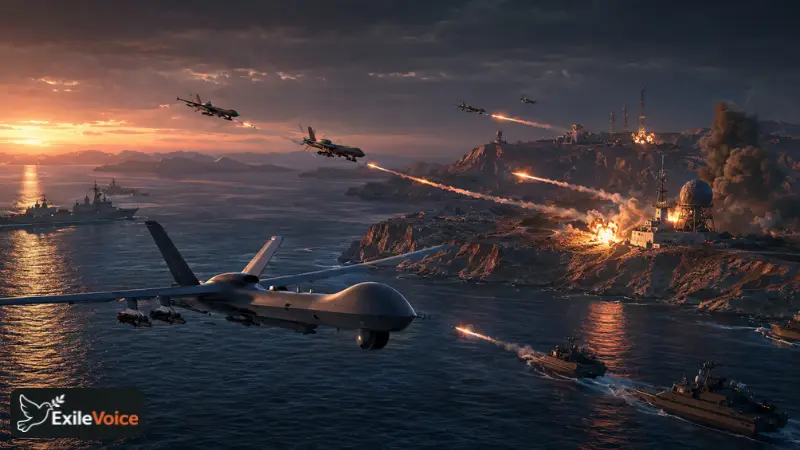
The recent military developments in the Persian Gulf have revealed a significant and perhaps unexpected participant in the kinetic strikes against Iranian assets: the United Arab Emirates (UAE). While the United States has taken the lead in naval transits, reports from regional intelligence and media outlets suggest that UAE platforms, including advanced drones and missile systems, were involved in strikes on Qeshm Island and other Iranian coastal surveillance nodes.
This represents a bold departure from the traditionally cautious and diplomatic stance the UAE has maintained in recent years. Historically, Abu Dhabi has balanced its security concerns with the need to protect its status as a global trade and tourism hub, often acting as a bridge for de-escalation. However, the 2026 landscape shows a UAE that is increasingly willing to integrate its military capabilities with U.S. "Project Freedom" objectives.
The motivation for this shift is likely twofold. First, there is a growing realization within the GCC that Iranian "asymmetric" tactics in the Strait of Hormuz pose an existential threat to the economic diversification plans of the Gulf monarchies. If the Strait is not "free" in the Western sense, the massive investments in Neom and UAE's urban centers are at risk. Second, the UAE appears to be betting on the "Trumpian" model of peace through strength, calculating that a decisive blow to Iran’s naval and surveillance capabilities is the only way to ensure long-term stability.
However, this aggressive posture is not uniform across the region. Oman, Qatar, and Kuwait remain hesitant, fearing that a full-scale war would devastate their economies. The UAE’s reported participation in strikes on Iranian soil could fracture the GCC’s unified front and draw the Emirates into a direct retaliatory cycle with Tehran. As the "shadow war" turns into a "hot war," the UAE’s move signals that the era of hedging is over; the Gulf is now a theater of active coalition warfare.