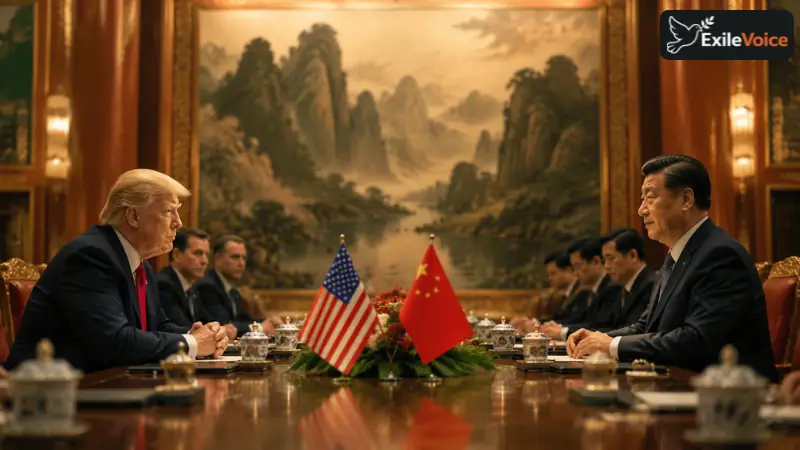
The mid-May 2026 summit in Beijing between US President Donald Trump and Chinese President Xi Jinping has signaled a profound structural transformation in global geopolitics. For decades, international relations theorists have warned of the "Thucydides Trap", a structural stress that occurs when an ascendant power challenges an incumbent hegemon. Historically, this dynamic has resulted in catastrophic conflict. During the opening sessions at the Great Hall of the People, this theoretical construct transitioned into an explicit diplomatic reality. Observers noted an unprecedented divergence in diplomatic posture, behavioral economics, and strategic communication between the two heads of state, reflecting a broader recalibration of global authority.
Western intelligence and geopolitical analysts have expressed deep concern over the asymmetric optics of the meeting. President Trump approached the summit utilizing high-level personal flattery, repeatedly characterizing President Xi as one of the world's greatest historical leaders. While the American administration sought to present this as an agile deal-making strategy designed to extract trade concessions, global policy experts viewed it as an unprecedented concession of ideological territory. Conversely, President Xi rejected reciprocal standard flatteries, maintaining a disciplined adherence to a highly calculated, scripted state posture. This rigid demeanor communicates a clear message: Beijing no longer views itself as a junior partner or a secondary global power, but as a structural equal operating from a position of systemic advantage.
This supreme state confidence was underscored by an explicit, blunt warning delivered by President Xi regarding the Taiwan sovereignty dispute. The Chinese administration cautioned that Washington must navigate cross-strait relations with extreme caution, warning that a failure to respect sovereign red lines would lead inevitably to direct military conflict. Historical comparisons reveal the magnitude of this shift. While intense rhetorical postures characterized the Maoist era, Chinese foreign policy under Deng Xiaoping, Jiang Zemin, and Hu Jintao consistently prioritized a cautious, low-profile approach toward the United States, often summarized as "hide your strength and bide your time." The overt willingness of the current Chinese administration to issue direct warnings on home soil demonstrates that Beijing believes the window of strategic vulnerability has closed.
This geopolitical assertiveness is significantly amplified by the strategic overextension of the United States in secondary theaters, most notably the escalating conflict with Iran. Beijing perceives the American military and financial apparatus as trapped in an open-ended war of attrition in the Middle East. This entangement limits Washington's capability to execute a meaningful pivot to the Indo-Pacific.
Concurrently, President Xi strategically introduced the Thucydides Trap framework directly into bilateral discussions, urging the United States to abandon its legacy "competitor" framework. Beijing argues that the relationship must be redefined around co-equal management of global stability. This rhetorical shift attempts to delegitimize American unilateralism, replacing it with a bipolar framework where Chinese consent is mandatory for global governance. As Washington wrestles with domestic polarization and multi-theater security commitments, Beijing is actively using the summit to formalize a multipolar world order.