

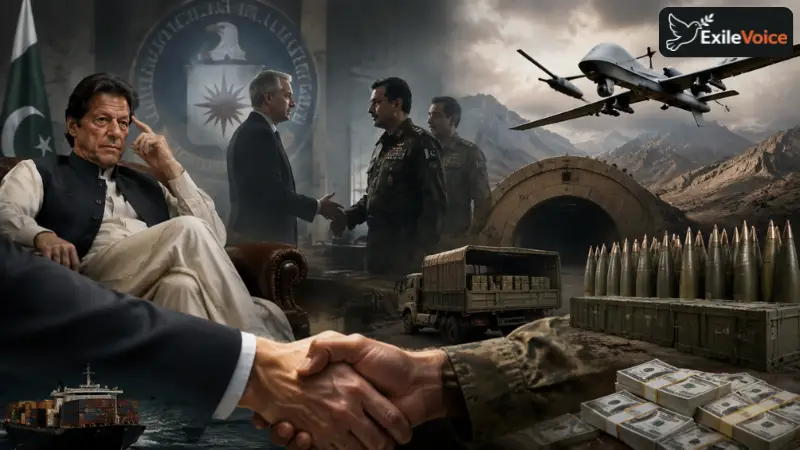
The geopolitical paradigm governing United States-Pakistan relations has undergone a foundational shift over the last half-decade, pivoting from deep-seated mutual suspicion to a calculated political embrace. According to a landmark investigative report by Drop Site News, authored by veteran journalists Ryan Grim, Murtaza Hussain, and Waqas Ahmed, the structural mechanics behind this transformation reveal how the American defense and intelligence apparatus systematically worked to secure their strategic interests. Central to this geopolitical evolution was the political neutralization of former Prime Minister Imran Khan, whose stubborn adherence to an independent foreign policy directly clashed with Washington's post-withdrawal regional designs.
The fracture in the relationship crystallized in June 2021, when Central Intelligence Agency (CIA) Director William J. Burns made a high-stakes, unannounced visit to Islamabad. In the wake of the planned American military withdrawal from Afghanistan, Burns arrived with a singular mission: to secure sovereign Pakistani territory for US military drone bases. These bases were deemed essential by the Pentagon to maintain over-the-horizon counterterrorism and surveillance capabilities over a rapidly destabilizing Afghanistan. However, the mission faced an unexpected obstacle in Imran Khan. Guided by strict diplomatic protocol and an anti-interventionist ideology, Khan refused to grant Burns an audience, noting that as head of government, his diplomatic counterparts were sovereign heads of state, not intelligence directors.
This refusal was magnified weeks later when Khan gave his now-infamous "Absolutely Not" interview to Axios co-founder Jonathan Swan. By publicly declaring that Pakistan would under no circumstances lease its soil for foreign military actions within Afghanistan, Khan drew an unyielding diplomatic red line. For the American intelligence establishment and the Pentagon, this public defiance was viewed as an unacceptable provocation that threatened vital US security architectures. The fallout triggered a coordinated institutional reaction within both Washington and the upper echelons of the Pakistani military establishment, setting into motion a chain reaction aimed at structural realignment.
Following the ouster of the civilian administration in April 2022, the incoming military-backed coalition government, led by Prime Minister Shehbaz Sharif, immediately began reversing the previous administration's isolationist policy. The transformation was swift. Within months of Khan's removal, Pakistan quietly emerged as a critical strategic supplier of conventional artillery shells and munitions to Ukraine via Western intermediaries. This weapon pipeline, valued at roughly $900 million, provided the precise 155mm ammunition required by European and American forces facing production deficits.
Crucially, multiple former US and Pakistani officials confirm that American institutional support for Pakistan's survival packages with the International Monetary Fund (IMF) was explicitly contingent upon the preservation of this military logistics corridor. In July 2023, the IMF approved a vital $3 billion Stand-By Arrangement for Pakistan, an economic lifeline directly facilitated by Washington as an implicit quid pro quo for military compliance. This integration of global financial mechanisms with security objectives demonstrates how thoroughly the US learned to stop worrying about domestic political instability in Islamabad, choosing instead to celebrate a highly compliant, non-ideological military-backed regime.
By the time the global landscape shifted into early 2025 with the return of Donald Trump to the White House, the bureaucratic entrenchment of this relationship was absolute. While newly appointed civilian leaders like Secretary of State Marco Rubio initially questioned the moral and democratic validity of supporting a compromised, election-rigging military regime, the institutional weight of the Pentagon and the CIA ultimately won out. The defense establishment successfully briefed the new executive branch on the indispensable nature of Pakistan’s military cooperation, ensuring that geopolitical stability and arms procurement took precedence over democratic principles.

