

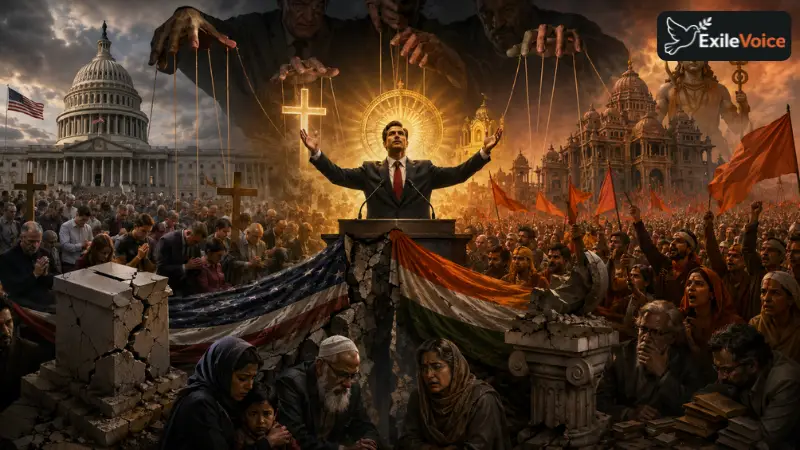
The intersecting dynamics of faith, national identity, and electoral strategy have taken center stage in global political discourse, raising fundamental questions about the future of secular governance. A vivid demonstration of this trend occurred on the National Mall in Washington, D.C., where a massive prayer festival drew thousands of participants under explicit political patronage. The event, held as part of the broader celebrations marking the 250th anniversary of the American foundational era, has drawn sharp criticism from constitutional purists who view it as an unprecedented blurring of the line separating church and state.
Historically, modern American administrations have maintained a calculated institutional distance from endorsing highly specific religious orthodoxies during official public gatherings. However, recent executive strategies have shifted toward a public alignment with evangelical conservative groups. High-ranking state officials, including the Secretary of State, have drawn widespread attention by publicly proclaiming specific religious traditions as the foundational "soul of the nation," while dismissing pre-Christian or non-Abrahamic civilizations as lacking historic direction. This explicit cultural hierarchy has sparked intense debate over who is included in the modern definition of national identity.
This tactical deployment of religious sentiment is not unique to the West; it reflects a broader, highly synchronized global political phenomenon. In South Asia, the ruling elite under Prime Minister Narendra Modi and the Rashtriya Swayamsevak Sangh (RSS) have masterfully utilized majority religious identity to build an unassailable electoral coalition. Despite comprising over eighty percent of the domestic population, the majority community is frequently mobilized through a narrative of historic grievance and existential threat from minority groups. The striking parallels between Western evangelical political messaging and Eastern majoritarian nationalism highlight a universal blueprint: when economic or structural policies fail to secure a reliable voter base, political managers turn to absolute cultural identities to solidify power.
An analysis of underlying data reveals the structural drivers behind this reliance on identity politics. In the United States, recent aggregate polling across major research platforms, including the New York Times/Siena, YouGov, and Ipsos, indicates that the current administration faces steep net disapproval ratings, often hovering between fifty-five and over sixty percent. With critical mid-term legislative elections on the horizon, the deliberate cultivation of a passionate, faith-based voter bloc functions as an essential survival strategy. When standard policy achievements fail to rally the electorate, intensifying cultural anxieties ensures maximum voter turnout among the core base.
This strategy relies heavily on a comprehensive revision of national history. Political speeches at recent faith rallies have actively sought to discredit critical historical analysis taught in academic institutions. Efforts by historians and civil rights advocates to address historical injustices, such as the legacy of chattel slavery, the systemic displacement of indigenous populations, and institutional bias against minorities, are increasingly labeled by conservative politicians as "sinister ideologies" designed to sow discord. By rejecting critical history, political leaders seek to construct an unblemished, divinely sanctioned national myth that demands absolute loyalty.
The long-term consequences of replacing civic nationalism with religious majoritarianism are deeply destabilizing for multi-ethnic societies. When state actors validate the narrative that a nation belongs primarily to one dominant religious group, it systematically undermines the social contract protecting minorities. Intellectuals, civil libertarians, and secular advocates across various faiths warn that this trend invariably leads to heightened social friction, institutional alienation, and localized violence. Safeguarding the future of pluralistic democracies will depend on the ability of independent civic institutions to resist the weaponization of faith and re-establish common citizenship as the primary metric of national belonging.

