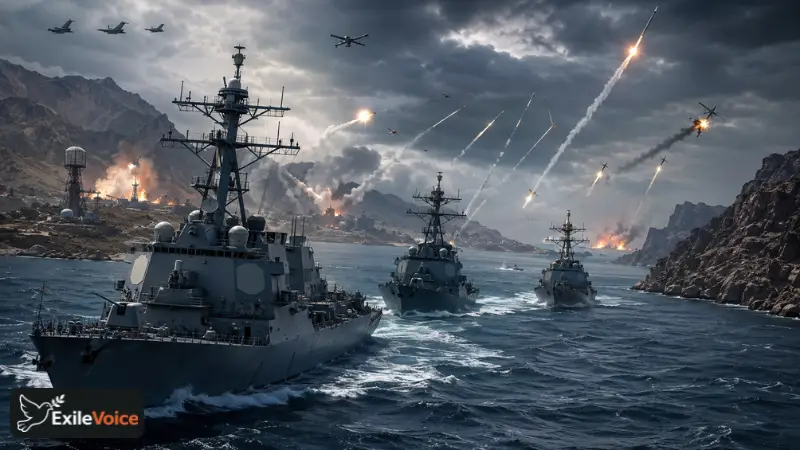
The geopolitical landscape of the Persian Gulf has undergone a tectonic shift in the early days of May 2026. What was initially perceived as a period of cooling tensions under a fragile ceasefire has rapidly evolved into a high-stakes display of military "músculo" and strategic brinkmanship. The recent successful transit of three U.S. Navy destroyers through the Strait of Hormuz, while under active fire from Iranian forces, marks the definitive end of the "wait-and-see" approach and the beginning of a new American-led control paradigm in the region.
This escalation is not merely a localized skirmish but a calculated effort by the Trump administration to reset the rules of engagement in the world’s most critical maritime chokepoint. By pushing advanced naval assets through the Strait despite drone and missile barrages, the United States is signaling to both allies and adversaries that it possesses the technical and tactical capability to override Iranian denial strategies. President Trump’s rhetoric on social media, characterized by vivid descriptions of Iranian drones falling "like butterflies to their graves," underscores a shift toward a more aggressive, humiliating form of psychological warfare intended to devalue Iranian military prestige.
The strategic objective appears to be the establishment of a "Power Projection" model that precedes a major summit with Chinese President Xi Jinping. By demonstrating that the U.S. can unilaterally secure, or disrupt, the flow of energy, Washington enters negotiations with Beijing from a position of renewed maritime hegemony. However, this "militarist diplomacy" carries immense risks. The reported strikes on Iranian coastal nodes such as Bandar Abbas and Minab represent a breach of traditional "grey zone" conflict boundaries, moving the theater from the sea to sovereign Iranian soil.
Furthermore, the involvement of regional players like the UAE adds a layer of complexity. Reports suggesting that UAE platforms were used for strikes on Qeshm Island indicate a hardening of the GCC bloc’s stance, with the exception of neutral parties like Oman. This regional polarization makes a return to the negotiating table increasingly difficult, as the conflict is no longer just about nuclear proliferation but about the fundamental order of global trade.