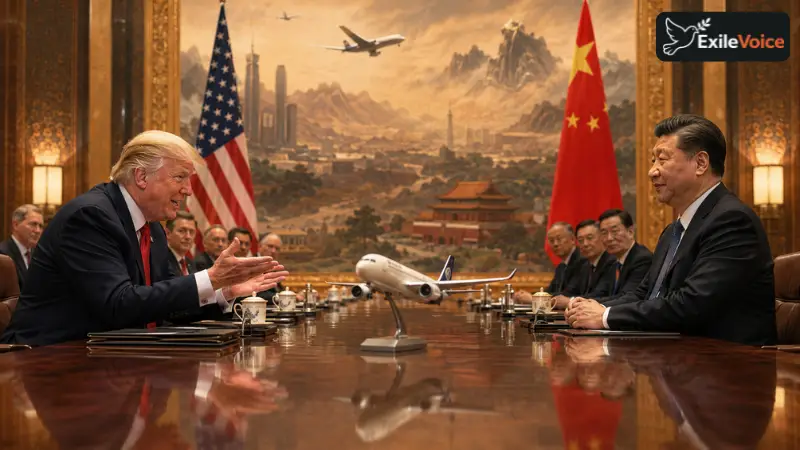
The diplomatic engagement between U.S. President Donald Trump and Chinese President Xi Jinping in May 2026 has become a focal point for international relations analysts. Observers have noted a profound disparity in the "body language" and strategic positioning of the two leaders. While President Trump engaged in what analysts describe as excessive "flattery," labeling Xi an "extraordinary leader" to secure personal rapport, President Xi maintained a rigid, scripted, and professional demeanor. This contrast is being interpreted as a visual representation of shifting global power: China no longer views itself as a secondary power but as an "equal" to the United States.
A significant highlight of this summit was President Xi’s reference to the "Thucydides Trap", a term coined by Harvard Professor Graham Allison to describe the historical tendency toward conflict when a rising power (China) threatens to displace an incumbent power (the US). By using this American academic framework, Xi signaled that China is acutely aware of the systemic risks and is demanding a change in American rhetoric, from viewing China as a "competitor" to seeing it as a partner in global stability.
Furthermore, the economic dimension of the visit revealed underlying tensions. While Trump announced a deal for China to purchase 200 Boeing aircraft, Boeing’s stock paradoxically plummeted. Investors were disappointed because the market had anticipated a 500-aircraft deal to meet China’s projected need for 9,000 commercial planes over the next 20 years. This suggests that China is strategically using its massive market share as leverage, potentially favoring European competitors like Airbus if U.S. relations do not improve on Chinese terms.