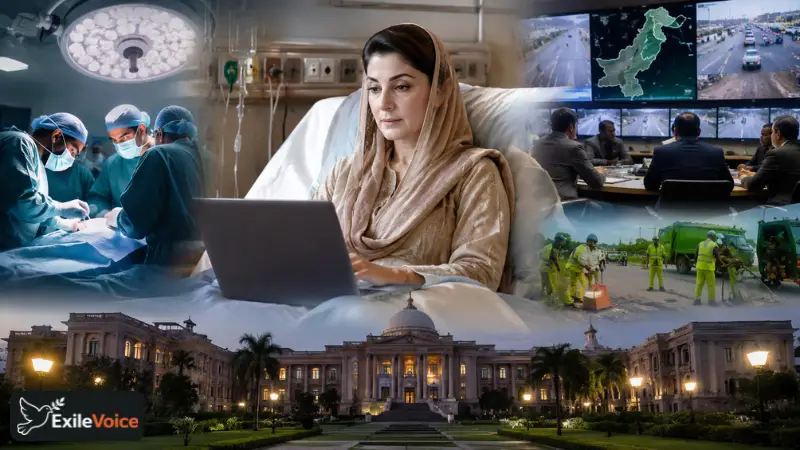
A significant communication breakdown recently emerged from the official channels of the Punjab Chief Minister’s Office, casting a spotlight on the public relations strategy of the ruling elite. Official announcements confirmed that Punjab Chief Minister Maryam Nawaz underwent a "major surgery" at Sharif Medical City Hospital in Lahore. While the administration immediately sought to reassure the public that she had been successfully discharged and moved to her residence, the accompanying narrative sparked substantial institutional and public skepticism.
The controversy stems from a public statement issued by Senior Provincial Minister Marriyum Aurangzeb. The communication asserted that despite undergoing a major surgical procedure, which inherently involves high-level anesthesia, post-operative recovery, and clinical isolation, the Chief Minister continuously and directly managed all complex provincial operations from her hospital bed. According to the official statement, these responsibilities included directly overseeing provincial security matrices, large-scale sanitation campaigns during the festive period, and routine administrative governance.
From an administrative and clinical standpoint, this dual narrative presents a profound contradiction. A major medical intervention demands strict physical rest and temporary cognitive disengagement from state affairs to ensure patient safety and proper healing. By attempting to overlay a narrative of extreme administrative efficiency onto a serious medical event, the government's media team inadvertently compromised the credibility of both assertions. If the surgical procedure was indeed a major medical event, executing real-time executive authority over a province of over 120 million people is practically and medically unfeasible. Conversely, if executive duties were actively maintained without interruption, it raises questions about the transparency and severity of the reported medical diagnosis.
This incident underscores a broader structural phenomenon within the current administrative setup of Punjab. Political analysts observe that the ruling dispensation frequently relies on an intensive public relations framework where image management takes precedence over institutional transparency. The administrative machinery appears heavily reliant on a core group of senior strategists and bureaucrats who manage actual policy formulation and day-to-day governance, while the political leadership functions primarily as the public face of the administration. When the public relations apparatus attempts to orchestrate a hyper-efficient image under medically impossible circumstances, it creates an institutional credibility gap. For state institutions and the public, this highlights the critical need for transparent, sober, and accurate communication regarding the health and operational capacity of top constitutional officeholders.