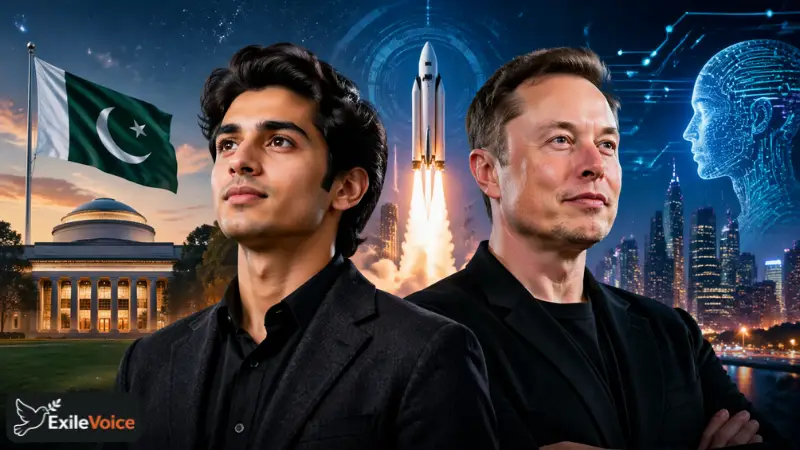
The global technology landscape is witnessing a seismic shift as young innovators from emerging markets begin to command the attention of the world’s most influential investors. The recent success of Saleh Asif, a 26-year-old MIT graduate and Pakistani entrepreneur, serves as a masterclass in how academic rigor combined with high-venture marketing can lead to billion-dollar valuations. Asif’s startup, which focuses on cutting-edge Artificial Intelligence (AI) and technology solutions, has recently secured a massive investment from Elon Musk’s corporate ecosystem, catapulting his net worth to an estimated $1.4 billion.
This achievement is not an "overnight success" but the culmination of years of intensive research and development within the world’s leading technological hubs. For Pakistan, Asif’s rise to become the fourth richest person in the country, at such a remarkably young age, highlights a critical truth: the talent exists, but the "enabling environment" is often missing.
Drawing parallels to high-venture marketing courses taught at leading universities, we see that the bridge between a brilliant prototype and a market-disrupting product is the ability to identify cross-sector applications. For instance, technologies originally designed for cosmetic analysis, such as measuring facial wrinkles, have historically pivoted into the medical sector for early skin cancer detection. Similarly, Asif’s venture represents a sophisticated blend of engineering and AI that solves complex, high-value problems, making it an irresistible target for Silicon Valley capital.
The lesson for developing economies is clear. To produce more innovators like Saleh Asif, there must be a structural shift toward supporting research that addresses global needs rather than just local challenges. When a startup’s frequency and innovation align with global trends, even the most traditional sectors are forced to take notice. Asif’s journey from a student at MIT to a billionaire partner of Elon Musk is a beacon for the next generation of tech leaders, proving that geographical origins are no longer a barrier to global dominance in the AI era.