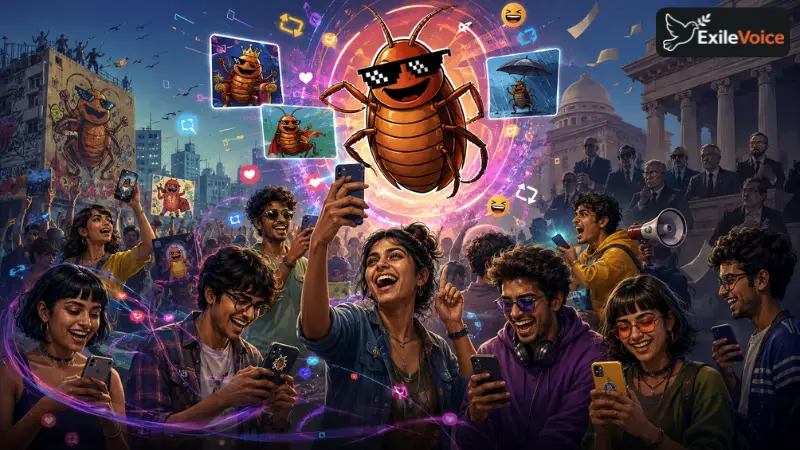
A remarkable and unprecedented political phenomenon is unfolding across India’s digital landscape as a satirical movement known as the Cockroach Janata Party disrupts mainstream political discourse. What began as a spontaneous, localized protest against institutional elitism has rapidly transformed into a massive Gen Z driven social media movement. Within a mere 48 hours of its launch, the movement’s digital platforms amassed over six million followers on Instagram, shattering digital engagement records previously held by established political entities, including the ruling Bharatiya Janata Party. This explosive growth has caught political analysts, intelligence networks, and mainstream media outlets off guard, sparking intense debates regarding the changing nature of youth political mobilization in the digital era.
The genesis of this unusual movement traces back to controversial remarks made by a prominent Indian judicial figure, Justice Kant, who publicly dismissed vocal young digital activists by comparing them to cockroaches infesting social media platforms. The derogatory comparison, intended to diminish the validity of youth criticism regarding governance and economic stagnation, backfired completely. Instead of being silenced, a young digital content creator named Abhijit hijacked the insult and repurposed it into a badge of honor. By establishing the Cockroach Janata Party online, Abhijit provided an immediate outlet for millions of disenfranchised citizens. While conspiracy theorists and established politicians have alleged that the rapid expansion must be funded by deep-state networks or underground political opposition, independent investigations confirm that the movement is a genuine, organic manifestation of youth discontent.
Prominent independent political commentators, including Dhruv Rathee, have analyzed the phenomenon as a profound reflection of systemic frustration building up within the Indian youth demographic. For years, the younger generation has faced severe economic challenges, characterized by hyper-inflation, a lack of institutional transparency, and high unemployment rates among educated individuals. When institutional leaders respond to these legitimate socioeconomic grievances with insults rather than policy solutions, it alienates the populace. The Cockroach Janata Party uses hyper-satirical memes, synchronized digital trends, and absurdist humor to bypass traditional political censorship and mock the self-important rhetoric of bureaucratic state officials.
This movement represents a structural shift in how political resistance operates in South Asia. Traditional political parties rely on extensive corporate funding, physical patronage networks, and mainstream media control to mobilize voters. In contrast, the Cockroach Janata Party operates entirely within the decentralized digital ecosystem, utilizing the short-form video algorithms of Instagram and X to build a community. The satirical party does not necessarily seek to govern in the traditional sense; rather, it functions as an aggressive counter-cultural mirror reflecting the perceived corruption, visual vanity, and systemic decay of the political status quo.
As the digital movement continues to expand, it sends a clear warning signal to politicians, judicial bodies, and state bureaucrats across the region. The youth population is no longer willing to accept patronizing governance or economic disenfranchisement. By turning a judicial insult into a powerful digital campaign, India’s Gen Z has demonstrated that humor and digital connectivity can challenge established institutional powers, rewriting the rules of modern political engagement.