The fragile peace in the Middle East has faced a severe tremor as the four-week ceasefire, brokered in part by Pakistan, appears to have been "jolted" by a series of aggressive escalations between the United States and Iran. According to recent reports from the Wall Street Journal and Bloomberg, the geopolitical temperature has shifted from cautious diplomacy back to the brink of active conflict. Central to this resurgence of hostility is the launch of "Operation Freedom" by the Trump administration, a title that critics and Iranian officials alike have labeled as a potential precursor to a "Project Deadlock."
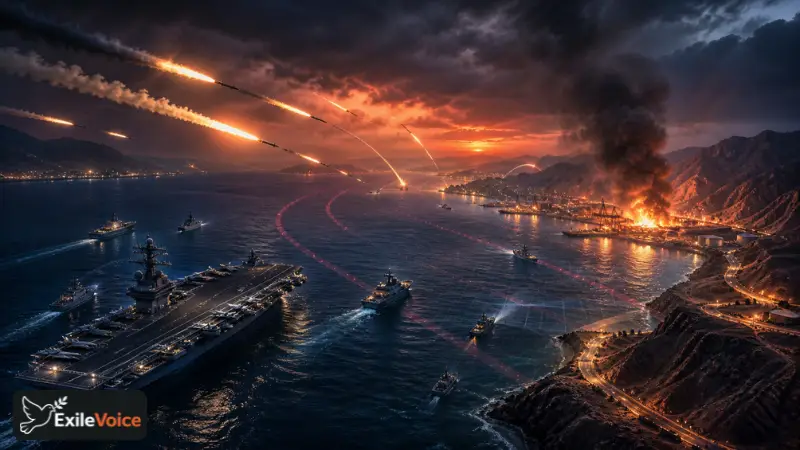
The stakes were raised significantly when the Iranian military published an official map that effectively signals a "blockade" or a "siege" mentality over the Strait of Hormuz. For the first time in recent history, Iran has explicitly demarcated a "horse-shoe" zone spanning from the Saudi coast to the UAE, claiming it as their sovereign territory and challenging any international vessel to transit without consequence. This isn't merely rhetorical posturing; it has already translated into kinetic action. Reports confirm that Iran launched a barrage of ballistic and cruise missiles aimed at the UAE, specifically targeting Fujairah, one of the region's most critical ports that serves as a vital bypass to the Strait of Hormuz.
The global response has been swift and condemnatory. Members of the GCC, along with France, Germany, and the European Union, have voiced grave concerns over the violation of UAE sovereignty. President Trump has countered Iranian aggression with the most severe language possible, threatening to "destroy and blow them off the face of the earth" if American interests or allies are further compromised. Meanwhile, the human cost of this shadow war continues to climb, with a "Death Meter" tracking thousands of casualties across Iran, Lebanon, Iraq, and Jordan.
As the world watches the next 24 to 48 hours with bated breath, Pakistan finds itself in a precarious yet unique position. While the nation has largely fallen off the mainstream news cycle, it continues to act as a quiet mediator. This was recently evidenced by Pakistan’s role in receiving and repatriating Iranian sailors seized by the U.S. from the tanker TV Moss. The situation remains a powder keg, with the potential for regional expansion that could disrupt global energy markets and security for years to come.