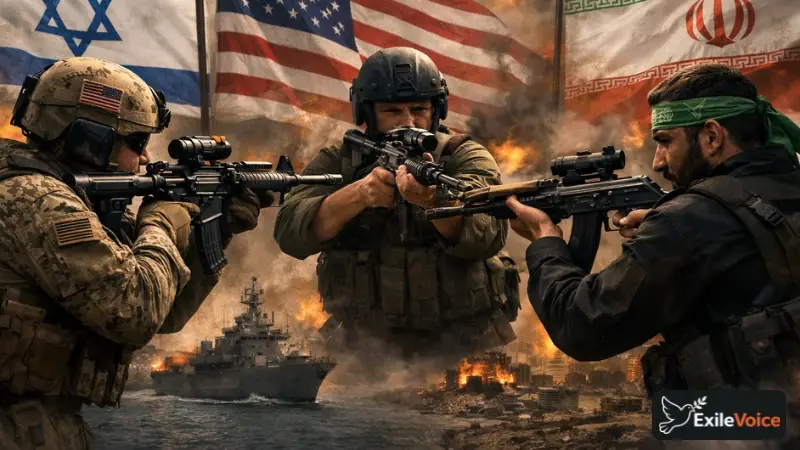
The current conflict in the Middle East has evolved into what strategists are now calling a "Mexican Standoff", a high-stakes "Persian Puzzle" where multiple regional and global actors are locked in a position where no one can win, yet every action triggers a catastrophic reaction. Unlike a traditional standoff between two parties, this scenario involves three or more factions, the United States, Israel, and Iran (along with its regional allies), each with weapons drawn and pointed. If any side opens fire, the resulting chain reaction ensures that all parties suffer significant, potentially irreparable damage.
This geopolitical deadlock has entered its sixth week, characterized by a series of escalatory "shocks." Despite heavy losses in Iran, where over 2,000 people have reportedly been martyred, the Iranian leadership remains defiant. This defiance is mirrored in Lebanon, Iraq, and across the Gulf states, where the impact of the war is being felt by civilians and military personnel alike. The survival of the Iranian regime in the face of such pressure is being interpreted by some as a strategic victory, even as the human and infrastructural cost continues to mount.
The situation is further complicated by the volatile rhetoric emerging from Washington. President Donald J. Trump’s recent public outbursts, including the use of explicit language and direct threats to Iranian infrastructure, have signaled a breakdown in traditional diplomatic decorum. This "unhinged" communication style has not only alienated international partners but has also caused friction within the U.S. political landscape. As the administration’s 24-hour deadline for Iran to reopen the Strait of Hormuz approaches, the world watches to see if this verbal brinkmanship will transition into a full-scale kinetic engagement.
Adding to the complexity is the domestic pressure within Israel. Prime Minister Netanyahu faces increasing opposition from both right-wing factions and a growing protest movement. Meanwhile, in the West, a shift in media narrative is occurring, with documentaries and reports increasingly highlighting the human cost of the war and questioning the strategic objectives of the current military campaign. This multi-layered "standoff" ensures that even "victory" for any party would be pyrrhic, as the regional security architecture is systematically dismantled.