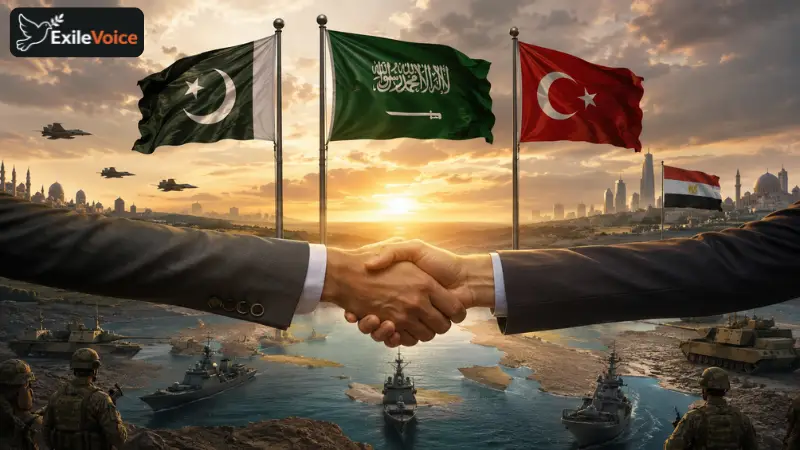
Recent regional developments have brought to light the emergence of a high-level trilateral defense agreement signed in Makkah involving key Muslim-majority nations, specifically Pakistan, Saudi Arabia, and Turkey, with reports indicating Egypt’s imminent inclusion. Frequently characterized in local media narratives as an "Islamic NATO," this alliance has sparked widespread public debate regarding its strategic intent, military posture, and potential impact on the broader Middle East and South Asia.
Strategic analysts and foreign policy observers emphasize that while the partnership is publicly framed around collective security and regional cooperation, its operational architecture mirrors defensive frameworks designed to counter specific geopolitical threats. Historically, security architecture in the Persian Gulf has been dominated by United States Central Command (CENTCOM) and its associated forward-operating bases across Qatar, Bahrain, Kuwait, and the United Arab Emirates. However, evolving security paradigms and the neutralization of conventional deterrence mechanisms have prompted regional powers to forge independent multilateral defense capabilities.
Central to this new security framework is Turkey’s extensive institutional experience as a leading North Atlantic Treaty Organization member. Turkey's integration into this Middle Eastern security equation brings advanced maritime strategy, intelligence coordination, and logistical capabilities. Furthermore, Turkish leadership has emphasized the necessity of a visible naval presence extending across the Mediterranean and the Red Sea toward the Suez Canal. This strategic positioning aims to secure energy corridors and project stability across vital maritime choke points.
At the same time, critical assessments indicate that the primary strategic calculus behind the coalition involves the containment and neutralization of Iranian regional influence. Following ongoing maritime disruptions and heightened tensions involving regional proxies, Gulf monarchies and allied states have sought robust defensive pacts to safeguard critical infrastructure and shipping lanes. While official statements maintain that the alliance is not directed against any single nation, its underlying defensive posture serves as a strategic counterweight to Tehran's missile and naval capabilities.
Public perception within participating nations often contrasts sharply with these geopolitical realities. Mass media outlets frequently romanticize the alliance as a pan-Islamic superpower designed to challenge Western and allied hegemony. However, expert analysis suggests that the coalition functions primarily as an alignment of pro-Western states seeking to stabilize the Persian Gulf, protect vital economic arteries, and rebalance regional power dynamics without direct military entanglement from external global superpowers.