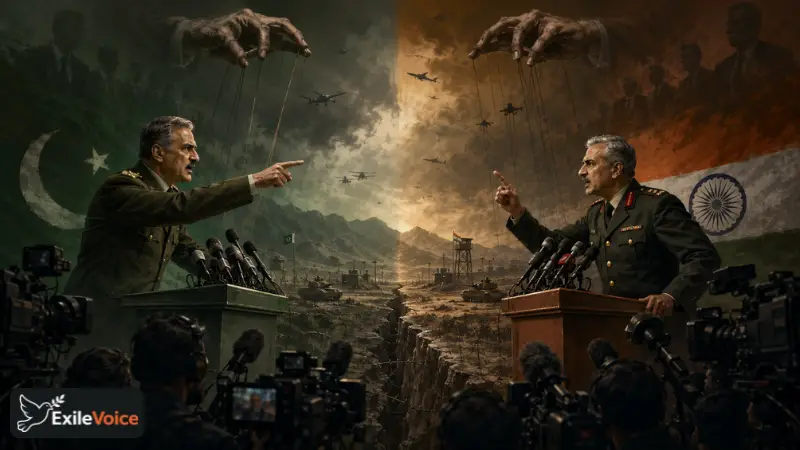
In the aftermath of Operation Sindoor, the discourse between the Indian and Pakistani military commands has taken an increasingly political and personal turn, raising concerns about the erosion of professional military decorum. A year later, the "war of words" has become as significant as the physical skirmishes. The recent press briefings from the Inter-Services Public Relations (ISPR) in Pakistan and the various communiqués from Indian military leadership reveal a troubling trend: the use of military platforms to settle domestic political scores and engage in cultural signaling.
A primary point of contention is the naming and branding of operations. Operation "Sindoor" itself was a culturally loaded term, intended by the Indian government to honor the widows of fallen soldiers. However, the Pakistani military's critique of this name transitioned from strategic analysis into gendered rhetoric, labeling the term "unmanly" or "feminine." Such commentary misses the mark of professional military conduct and ignores the reality that modern armed forces on both sides of the border are increasingly integrated. Women serve in combat roles, fly fighter jets, and manage logistics; therefore, using "femininity" as a derogatory military critique is not only anachronistic but also an insult to the serving female officers within one's own ranks.
Furthermore, the accusation that the Indian military has become "politicized" by the ruling BJP and RSS ideologies is a potent observation, yet it carries a heavy irony when delivered by an establishment with a long history of domestic political intervention. When military spokespersons critique the "politicization" of an opponent, they often inadvertently highlight their own involvement in civil governance. This cross-border finger-pointing serves to distract from internal failures, whether it be election controversies in Pakistan or the influence of nationalist ideologies in the Indian officer corps.
The language of these briefings has also shifted from the "Queen’s English", the traditional language of both armies, to a more populist, "cafeteria-style" vernacular. While this might appeal to a local domestic audience, it damages the international credibility of the institutions. Military communication should ideally focus on de-escalation, professional assessments, and the maintenance of "hotlines" to prevent accidental war. Instead, the current trend favors "clout" over competence, with senior officers appearing on talk shows to spin narratives rather than focusing on the "barracks and boots" reality. To maintain regional stability, the military leadership of both nations must return to a standard of professional distance from politics, ensuring that the uniform remains a symbol of state defense rather than a tool for partisan propaganda.