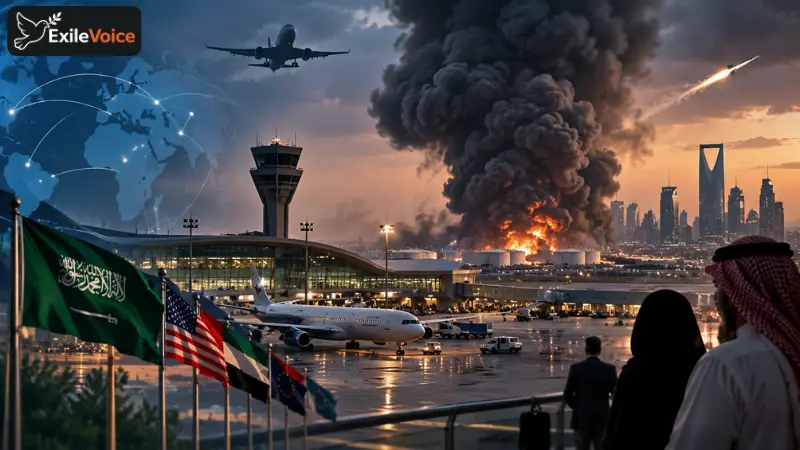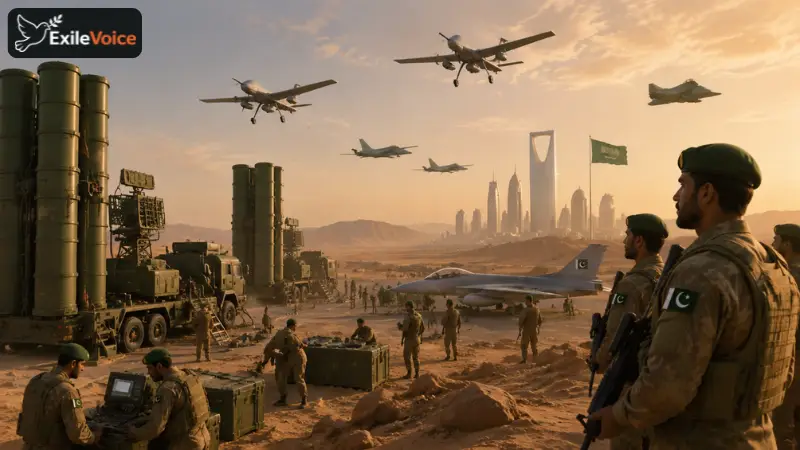
A highly significant and historically sensitive expansion of the bilateral defense relationship between Pakistan and the Kingdom of Saudi Arabia has been brought to light through a comprehensive investigative report published by Reuters. According to detailed defense metrics, the Pakistani military establishment has quietly executed a massive forward deployment of over 8,000 highly trained combat troops, multi-role fighter aircraft, advanced unmanned aerial vehicles (UAVs), and sophisticated strategic air defense networks directly into the sovereign territory of Saudi Arabia. This re-alignment marks a critical shift in regional security dynamics, moving beyond traditional advisory roles into active operational containment.
The most critical technological asset included in this forward deployment is the Chinese-manufactured HQ-9 advanced long-range surface-to-air missile defense system. The HQ-9 represents a cornerstone of Pakistan's domestic anti-access/area-denial (A2/AD) capabilities, originally procured and optimized to counter sophisticated aerial threats along Pakistan's eastern border, specifically neutralizing India's Russian-made air assets and missile platforms. The decision to dismantle and transport a premier strategic air defense asset from the domestic defense perimeter to the Arabian Peninsula demonstrates the deep institutional commitment, and the intense financial dependencies, driving the current high command's defense export strategy.
The operational and financial parameters of this bilateral defense pact, as detailed by international security analysts, reveal a highly transactional framework. Under the strict terms of the agreement, the Pakistani military retains absolute tactical command, maintenance responsibility, and technical oversight over all forward-deployed hardware, missile batteries, and personnel configurations. In return, the Kingdom of Saudi Arabia has assumed 100 percent of the operational, logistical, and infrastructural expenditures associated with the deployment. This includes the direct financing of all fuel supplies, base maintenance costs, hardware transport logistics, and, crucially, the payment of all personnel salaries in hard foreign currency.
This financial mechanism holds immense economic implications for the inner workings of the Pakistani military apparatus. The 8,000 personnel deployed on this prolonged foreign mission, encompassing combat infantrymen, specialized radar technicians, maintenance engineers, field officers, and high-ranking command elements up to the level of Major Generals, are receiving their salaries, field allowances, and danger pay entirely in US Dollars or Saudi Riyals. This dynamic transforms the deployment into a highly lucrative foreign assignment for military personnel, generating powerful internal institutional incentives to sustain and expand such arrangements, even at the cost of stretching domestic defense lines thin during a period of heightened internal security instability.
Geopolitically, the deployment of the HQ-9 system along with squadrons of JF-17 Thunder multi-role fighter jets provides Saudi Arabia with a crucial layered air defense shield. This specialized shield is primarily aimed at intercepting complex low-altitude drone swarms and precision-guided ballistic missiles fired by regional non-state actors and hostile neighbors targeting Saudi energy infrastructure and urban centers. By integrating Chinese-tech platforms manned by experienced Pakistani operators, Riyadh is successfully diversifying its defense reliance away from purely Western defense systems, while simultaneously securing a highly disciplined, combat-ready regional army to protect its borders.
However, this massive outward transfer of premier military equipment and elite personnel raises serious questions regarding Pakistan's domestic defense readiness. With internal militancy experiencing a sharp resurgence along the western border with Afghanistan and complex standoff risks persisting along the eastern front, the reallocation of 8,000 combat troops and major air defense batteries represents a significant diversion of state resources. Critics point out that while this strategy successfully injects much-needed foreign currency into the military's institutional accounts and provides financial windfalls for individual officers, it leaves the domestic population exposed to evolving security vulnerabilities, highlighting a profound tension between institutional economic survival and national defense priorities.